
Finding the best ai for writing comes down to matching your specific task with the model built to handle it, whether you are drafting an urgent client email or producing a long-form marketing piece. No single AI model excels at every writing format equally. In this guide, we evaluate the top writing models available for daily professional tasks, long-form blogs, editorial polish, and bilingual workflows.
Last updated: November 2026
The Short Answer: Best AI for Writing by Task
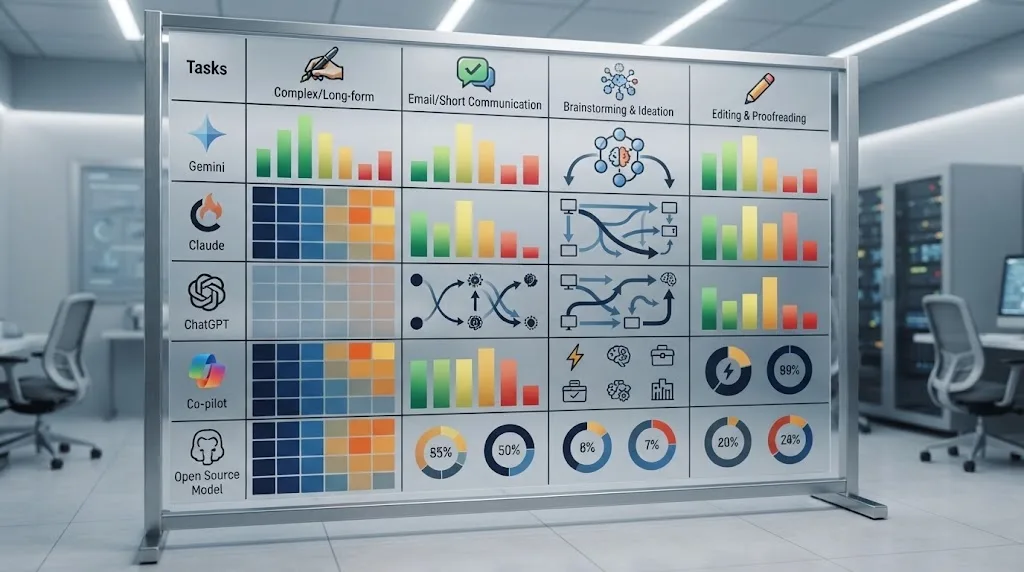
If you need a quick recommendation before diving into the details, here is how the top models stack up across primary writing categories based on recent testing.
| Writing Task | Top Model Pick | Key Strength |
|---|---|---|
| Business Emails & Reports | Anthropic Claude 3.5 Sonnet / OpenAI GPT-4.5 | Clarity, professional tone, minimal fluff |
| Long-Form Blogs & Content | Anthropic Claude 3.5 Sonnet | Coherence, narrative flow, nuance |
| Editing & Rewriting | OpenAI GPT-4o / Claude 3.5 Sonnet | Precision grammar fixing and style adaptation |
| Arabic & Bilingual Copy | OpenAI GPT-4.5 / Anthropic Claude 3.5 Sonnet | Cultural idiom handling and modern Standard Arabic fluency |
How We Tested
To identify the best ai writer options, we evaluated leading large language models across real-world workflows used by professionals and freelancers in Dubai, Riyadh, and across the Gulf. We tested each model using identical prompts for structural coherence, tone preservation, avoidance of filler words, and factual accuracy. For deeper comparisons on foundational model behavior, you can review our detailed breakdown on Claude vs ChatGPT.
We avoided generic marketing benchmarks in favor of practical testing: drafting client proposals under tight deadlines, revising dense reports after standard UAE work hours, and translating regional business correspondence between English and Arabic.
Business Writing: Emails and Reports
Professional communication requires conciseness, precision, and an appropriate tone that respects business hierarchies without sounding overly robotic or overly casual. When drafting routine workplace correspondence, choosing the right assistant helps maintain consistent brand standards across remote teams.
For concise updates and structured management summaries, models with strong instruction-following capabilities perform best. For a complete guide on crafting effective daily correspondence, refer to our specialized resource on AI for professional emails.
Note: When writing internal reports or client-facing updates, always review the output for regional compliance and tone before hitting send.
Long-Form Content and Blogs
Producing comprehensive articles, white papers, or blog posts requires an AI that can maintain a consistent narrative arc over thousands of words without losing context or repeating phrases. Many models struggle with structural pacing, often front-loading all information into the introduction.
Anthropic Claude models consistently lead in long-form generation because of their superior handling of extended context windows and natural syntactic rhythm. They produce fewer clichés and require less editorial cleanup compared to older generation models. When building an expansive content library, utilizing an try several writing models in one chat workspace allows you to test both Claude and OpenAI models side-by-side on the exact same project brief.
Editing and Rewriting
Even the best ai for content writing benefits from a rigorous editing phase. AI tools excel at transforming unpolished rough drafts into tight, punchy copy, fixing passive voice, and adjusting tone from academic to conversational.
When using an ai writing assistant for editing, specify the target audience clearly. Instead of asking a model to “fix this text,” instruct it to “cut word count by twenty percent while keeping a professional, approachable tone.” This prevents the model from injecting overly dramatic vocabulary or hyperbolic transitions.
Tip: If you are concerned about maintaining human authenticity in polished text, be sure to read our separate guide on AI detectors to understand how modern verification tools evaluate machine-assisted prose.
Arabic and Bilingual Writing
For professionals working across Arabic and English markets in the GCC, multilingual capability is non-negotiable. Many AI models translate literally, resulting in awkward phrasing that lacks the nuance required for regional marketing or official correspondence.
High-end models handle Modern Standard Arabic (MSA) and regional business terminology with much greater fidelity. For an in-depth analysis of regional linguistic performance, capabilities, and prompting tips, explore our dedicated guide on (after publication) Best AI for Arabic.
Keeping Your Brand Voice
Maintaining a consistent voice across multiple writing sessions is often the hardest part of working with generative AI. Standard models reset their context with every new chat, forcing you to re-explain your brand guidelines, preferred formatting, and target audience over and over.
Using a collaborative workspace that retains persistent project memory eliminates this friction. When your writing assistant remembers your style guide, tone preferences, and past terminology choices, every drafted paragraph aligns with your established brand from the first sentence.
FAQ
Which AI model is best for creative storytelling?
Anthropic Claude models generally excel at creative writing, narrative pacing, and emotional nuance due to their training on human-like syntax and resistance to repetitive phrasing patterns.
Can AI completely replace human copywriters?
No. AI functions best as an advanced writing assistant that accelerates drafting, brainstorming, and editing, while human oversight remains essential for original research, empathy, and strategic direction.
How do I stop AI from using cliché corporate buzzwords?
You can prevent repetitive phrasing by explicitly forbidding specific buzzwords in your prompt (such as “delve,” “testament,” or “navigating”) and providing examples of your preferred direct writing style.
Is my business data safe when using AI writing tools?
Data privacy depends entirely on the platform you use. Enterprise-grade workspaces ensure that your prompts and uploaded documents are encrypted in transit and at rest, and are strictly excluded from model training data.
Key takeaways
Selecting the ideal AI writing tool depends entirely on your primary workflow, whether you manage corporate email correspondence, long-form educational blogs, or bilingual Arabic-English marketing campaigns.
- Match the model to the task: Claude leads in long-form structure, while OpenAI models excel at concise editing and data extraction.
- Maintain a consistent tone by storing your brand guidelines in persistent workspace memory rather than re-typing prompts.
- Always perform a final human review for regional nuance, factual accuracy, and compliance with local standards.
- Test multiple leading models inside a single collaborative interface to find the exact fit for your daily writing needs.
If you’d rather not juggle multiple subscriptions, tabs, and tools, you can try several writing models in one chat and combine every leading AI model in one workspace, with a 7-day free Pro trial.