For business leaders, CTOs, and marketing directors across the GCC, choosing the right artificial intelligence infrastructure is no longer an experiment; it is a core operational mandate. When evaluating the current enterprise landscape, the Grok vs Gemini debate represents a fascinating crossroads. If you need the bottom line immediately: choose Grok if your business relies on real-time market sentiment and unfiltered data processing, but choose Gemini if your team is deeply embedded in Google Workspace and requires processing massive documents, videos, and complex multimodal data.
The choice between these two platforms highlights the broader industry shift of xAI vs Google AI. We are no longer just comparing basic text generators; we are comparing entirely different philosophies of how AI should interact with the world. Grok acts as a high speed radar connected directly to the global nervous system of social media, while Gemini acts as a deeply integrated, highly capable analytical engine.
In this comprehensive 2026 analysis of Grok vs Gemini, we will strip away the marketing hype. We will objectively compare Grok pricing against Gemini pricing, evaluate Grok 4 vs Gemini 3 in technical benchmarks, and determine the best AI for real-time information. By the end of this guide, you will have a clear, ROI-focused roadmap for which platform deserves your enterprise investment.
Executive Summary
- The Core Difference: The Grok vs Gemini comparison is fundamentally a choice between raw, real time social data access (Grok) and deep, enterprise grade multimodal integration (Gemini).
- Ecosystem Integration: Gemini connects flawlessly to your existing Google Docs, Drive, and Gmail. Grok lives primarily within the X (formerly Twitter) ecosystem.
- Cost Efficiency: When analyzing Grok pricing and Gemini pricing, Google currently offers a slightly more aggressive entry point for mid-tier users, while Grok requires premium investments for its flagship features.
- Coding Capabilities: In the battle of Grok vs Gemini for coding, both are exceptionally strong, but Gemini’s larger context window gives it an edge for massive repository debugging.
- Decision Framework: To explore how this fits into your broader IT strategy, consult our guide on [How to Choose the Right AI Model: A 5-Question Decision Framework → How to Choose the Right AI Model: A 5-Question Decision Framework (how-to-choose-ai-model)].
Quick Comparison Table
Before diving into the granular details of the Grok vs Gemini ecosystem, here is a high-level overview of how these two leading platforms stack up for business users in 2026.
| Feature / Capability | Grok (xAI) | Gemini (Google) |
| Primary Strength | Real-time social data and unfiltered wit | Multimodal reasoning (text, audio, video) |
| Current Flagship Model | Grok 4.x | Gemini 3.x |
| Ecosystem Integration | X (Twitter) Platform | Google Workspace & Android |
| Best Used For | Trend analysis, PR monitoring, quick coding | Document analysis, spreadsheet automation |
| Tone & Personality | Direct, rebellious, conversational | Professional, structured, safe |
For a broader perspective on how these models compare to the rest of the market, review our comprehensive [The Complete Guide to AI Models in 2026: Every Major LLM Compared → The Complete Guide to AI Models in 2026: Every Major LLM Compared (ai-models-complete-guide)].
What is Grok?
Developed by Elon Musk’s xAI, Grok was designed from the ground up to answer the “spicy” questions that other AI models typically reject. In the context of xAI vs Google AI, Grok represents the challenger brand. It is built to be witty, rebellious, and highly direct.
However, for a GCC business, Grok’s true value lies not in its humor, but in its data pipeline. Grok has exclusive, real-time access to the X platform data firehose. If a new consumer trend explodes in Dubai, or a sudden regulatory shift is announced in Saudi Arabia, Grok knows about it instantly—often hours before traditional search engines index the news articles.
This makes Grok the undisputed best AI for real-time information. For PR agencies, financial day-traders, and social media marketing directors, having an AI that can ingest and summarize millions of live social posts in seconds is an unprecedented operational advantage.
What is Gemini?
Gemini is Google’s crown jewel. Unlike earlier AI models that were built for text and had image capabilities bolted on later, Gemini was built from day one to be natively multimodal. This means it understands video, audio, code, and text simultaneously and seamlessly.
In any serious Grok vs Gemini evaluation, Gemini’s power comes from its environment. It lives where you already work. If your logistics company in Qatar operates entirely on Google Workspace, Gemini can open a massive PDF from your Google Drive, cross-reference it with pricing data in Google Sheets, and draft an email to your vendor in Gmail—all without you leaving the tab.
When you read a [Gemini vs Claude: Which Model Wins for Your Workflow? → Gemini vs Claude: Which Model Wins for Your Workflow? (gemini-vs-claude)] comparison, you see Gemini’s dominance in ecosystem fluidity. It is the safe, highly structured, deeply integrated powerhouse designed for massive corporate deployment.
Head-to-Head Comparison
To make an informed procurement decision, we must analyze Grok vs Gemini across the five dimensions that directly impact your company’s daily productivity and financial bottom line.
Pricing & Plans
Evaluating Grok pricing versus Gemini pricing reveals distinctly different corporate strategies. As of mid-2026, both platforms have segmented their offerings to capture different tiers of the market.
- Grok Pricing: Accessing the Grok ecosystem starts through X Premium, which currently sits at approximately $8 per month. This provides a highly capable entry-level experience. However, for enterprise users who require maximum compute power and the latest architecture, the flagship tier (e.g., Grok 4.20) runs notably higher, at approximately $40 per month.
- Gemini Pricing: Google has aggressively priced its ecosystem to ensure mass enterprise adoption. Following recent market shifts, their entry-level “Google AI Plus” sits around $4.99 per month. The robust, business-standard “Google AI Pro” tier remains highly competitive at roughly $19.99 to $20 per month.
Business Takeaway: If your goal is broad deployment across a 500-person team in the UAE, the Gemini pricing structure offers a much softer landing, especially if bundled with existing Google Cloud contracts. However, if you are a boutique trading desk relying on the best AI for real-time information, the premium Grok pricing is easily justified by the speed of its market insights.
Real-Time Knowledge & Personality
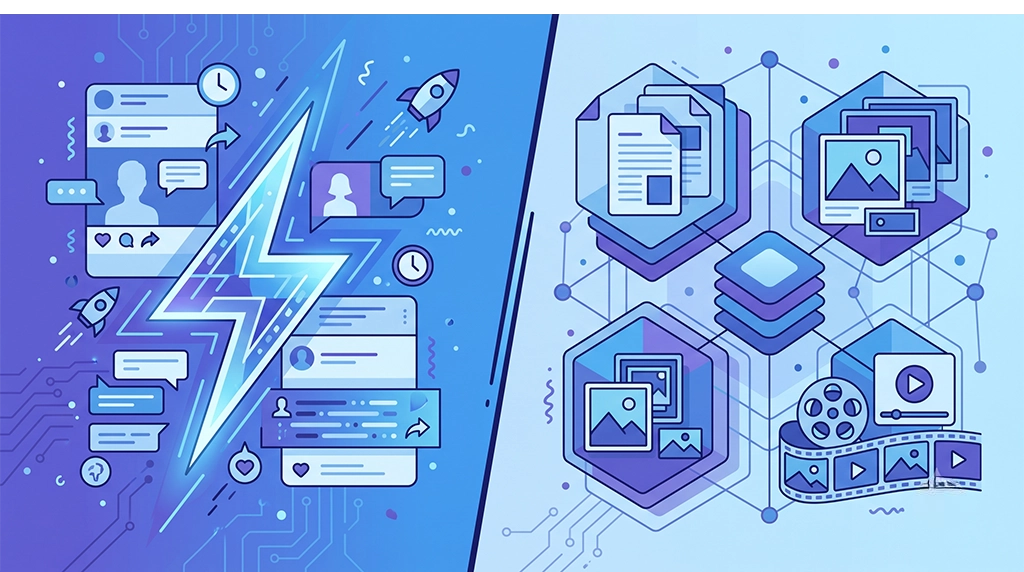
The debate of real-time AI vs multimodal AI is the defining characteristic of this head-to-head matchup.
Grok’s integration with the X platform means it can pull live sentiment analysis on a micro-scale. Imagine a retail brand launching a new product in Riyadh. Within minutes of the launch, the marketing director can ask Grok to summarize the live consumer reaction across the Middle East. Grok will pull exact quotes, detect shifting sentiment, and deliver it with a remarkably conversational, direct tone. It is, without question, the best AI for real-time information.
Gemini, conversely, relies on Google Search for its real-time data. While Google Search is the world’s most powerful index, there is an inherent delay between an event happening on social media and an article being published and indexed. Gemini’s personality is also strictly guarded. It is polite, objective, and highly corporate.
If you are evaluating AI tools strictly for research accuracy and verifiable source citations, you should also review our [Perplexity vs Gemini: Which AI Answers with Better Sources? → Perplexity vs Gemini: Which AI Answers with Better Sources? (perplexity-vs-gemini)] guide. But in the pure Grok vs Gemini speed race, Grok breaks the news first.
Reasoning & Multimodal Capabilities
When we elevate the comparison to Grok 4 vs Gemini 3, we enter the realm of heavy compute and complex reasoning. Here, the focus shifts from the real-time AI vs multimodal AI debate entirely into Google’s territory.
Gemini 3 is a multimodal leviathan. A structural engineering firm in Abu Dhabi can upload a 45-minute video of a drone inspecting a bridge, alongside a 200-page architectural PDF. Gemini can watch the video, read the document, and instantly point out a structural crack in the video that violates a safety code listed on page 142 of the PDF.
While Grok 4 has made massive strides in visual processing and logic, its architecture is still primarily optimized for speed and text-based wit. In rigorous, multi-step logical reasoning tests—such as analyzing massive datasets to predict supply chain bottlenecks—Grok 4 vs Gemini 3 benchmarks generally show Gemini holding a distinct advantage due to its massive context window and native multimodal design.
Coding & Technical Tasks
For CTOs and lead developers, evaluating Grok vs Gemini for coding is critical for engineering velocity. Both models are exceptional at writing Python, debugging JavaScript, and structuring databases.
- Gemini for Developers: Gemini excels when context is massive. If your team is refactoring a legacy application with 50,000 lines of code, Gemini’s massive context window allows you to upload the entire repository. It can track variables across dozens of files simultaneously. Furthermore, its integration into Android Studio makes it indispensable for mobile app developers.
- Grok for Developers: When testing Grok vs Gemini for coding, Grok shines in quick, iterative problem-solving. Developers often praise Grok for giving direct, raw answers without the overly verbose “fluff” that other models include. If a developer hits an obscure API error, Grok can instantly search the live X developer community to see if others are experiencing the exact same outage right now.
Both are elite tools, but if you want to see how they stack up against the original coding heavyweight, read our [Gemini vs ChatGPT: The 2026 Head-to-Head Comparison → Gemini vs ChatGPT: The 2026 Head-to-Head Comparison (gemini-vs-chatgpt)].
Ecosystem & Integrations
The final battleground in the xAI vs Google AI war is where the AI actually lives. AI is only useful if it integrates smoothly into your daily corporate workflow.
Gemini has an almost unfair advantage here. It is baked into the operating system of modern business. You can highlight a row in Google Sheets and ask Gemini to extrapolate the financial data. You can ask Gemini in Gmail to draft a response based on an attached Google Doc. For enterprises in the GCC that already rely heavily on Google Workspace, deploying Gemini requires zero new software adoption; it simply upgrades your existing tools.
Grok is currently a standalone destination. You go to Grok to get an answer, and then you manually copy that answer into your corporate workflow. While xAI is rapidly building out its API infrastructure for custom enterprise integrations, it cannot compete out-of-the-box with Google’s ubiquitous office suite.
Which Should You Choose?
After a deep evaluation of Grok vs Gemini, it is clear that neither model is objectively “better” in a vacuum. Your choice dictates your workflow. We strongly recommend adopting a use-case-driven approach to procurement.
Choose Grok if:
- Your business relies heavily on monitoring live public sentiment, breaking news, or social media trends.
- You are a financial analyst, PR manager, or digital marketer who requires the absolute best AI for real-time information.
- You prefer a direct, unfiltered AI personality that cuts straight to the point without corporate pleasantries.
- You want the fastest possible answers to isolated coding queries.
Choose Gemini if:
- Your company’s infrastructure is deeply tied to Google Workspace (Docs, Sheets, Drive).
- You need to analyze massive, complex files—such as hour-long video meetings, audio recordings, or 500-page legal PDFs.
- You require a highly professional, guarded, and structured AI assistant suitable for mass deployment across non-technical teams.
- Your primary concern is managing large-scale, multi-file coding repositories.
FAQs
- Is Grok vs Gemini pricing comparable for a large enterprise?
At scale, Google’s Gemini pricing often proves more cost-effective for general staff due to its lower-priced entry tiers and bundling options with Google Workspace. Grok pricing for its most advanced models requires a higher per-user monthly investment, making it better suited for specialized teams.
- Which model is the absolute best AI for real-time information?
Because it has a direct pipeline to the X platform, Grok is unparalleled at reading live, unfiltered human sentiment and breaking news literally as it happens, seconds before traditional search engines.
- In the Grok 4 vs Gemini 3 coding tests, which wins?
When evaluating Grok vs Gemini for coding, Gemini is superior for massive, multi-file codebases due to its huge context window. Grok is often preferred by developers for quick, isolated debugging and its direct, no-nonsense communication style.
- What is the main difference between xAI vs Google AI?
Google AI focuses on safety, broad ecosystem integration, and processing deep multimodal files . xAI focuses on speed, unfiltered access to real-time data, and maximum intellectual freedom.
- Can I use both models?
Yes. In fact, modern GCC enterprises rarely limit themselves to a single vendor.
Key Takeaways
- The Grok vs Gemini comparison is not about finding a single winner; it is about matching the tool to the task.
- Grok dominates the real-time AI vs multimodal AI debate when speed and live sentiment are required.
- Gemini is the undisputed champion of deep ecosystem integration and processing massive document/video files.
- Relying on a single AI provider is a strategic vulnerability in 2026.
Why choose just one?
Do not lock your enterprise into a single ecosystem. Lexika gives you both Grok and Gemini (plus every other major model) under one subscription, with smart routing to pick the right one per task [see how smart routing works]. Experience true AI flexibility today.