
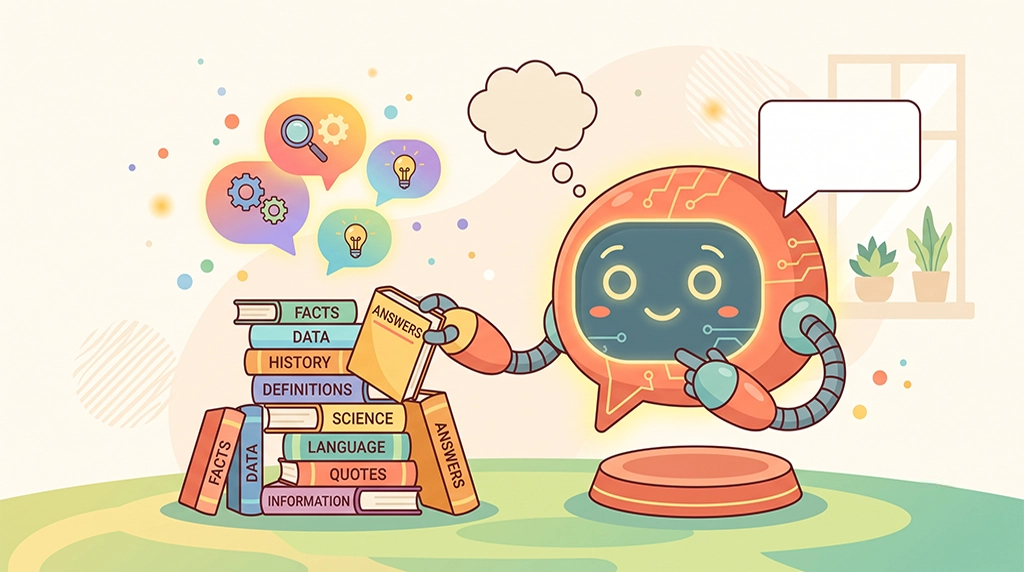
Time is the most valuable asset in the modern enterprise. For business leaders, CTOs, and marketing managers across the GCC—from supply chain hubs in Dubai to energy sectors in Saudi Arabia—understanding what is rag is the foundational step toward deploying reliable, enterprise-grade AI.
Simply put, retrieval-augmented generation is a framework that allows an AI model to “look things up” in an external, verified source before answering your question. Instead of relying solely on its internal memory—which can be outdated or flawed—the AI actively references your specific, proprietary documents, ensuring the output is accurate, secure, and trustworthy. This process drastically reduces the chances of the AI making up false information, which is a critical necessity for any business environment.
If your organization is exploring [AI fundamentals hub → What is Artificial Intelligence], mastering this concept is non-negotiable. Whether you are automating customer support in Qatar or analyzing financial compliance in Abu Dhabi, retrieval-augmented generation ensures your AI systems rely exclusively on factual, up-to-date company data. It elegantly bridges the gap between general AI capabilities and your highly specific business intelligence.
Executive Summary
- Retrieval-augmented generation forces an AI to search approved external databases for facts before it generates any response.
- This methodology is currently the single most effective way to prevent a costly ai hallucination in corporate, high-stakes environments.
- When comparing rag vs fine-tuning for business use, RAG is fundamentally faster, significantly more cost-effective, and much easier to update daily.
- The technology works by converting standard text into a searchable mathematical format using a vector database, allowing the AI to retrieve the exact context needed instantly.
RAG in One Sentence
Retrieval-augmented generation is a specialized technique that lets an AI model act like a professional taking an open-book test; it looks up verified facts from a reliable, private database before writing down its final, authoritative answer.
Why AI Models Need RAG (The Hallucination Problem)
To truly grasp why retrieval-augmented generation is a revolutionary step forward, we must first look at how standard AI operates out of the box.
When you ask a standard large language model a question, it relies entirely on its training data. It essentially tries to predict the next best word based on billions of patterns it learned in the past. If it does not explicitly know the answer to your niche business question, it will not necessarily admit ignorance. Instead, it might just guess. This confidently delivered, entirely fabricated answer is known in the tech industry as an ai hallucination.
If you want to dive deeper into [why chatbots make things up → What is an AI Hallucination?], it is crucial to understand that these errors happen because standard AI cannot instantly update its internal memory after its initial training is complete.
The Real-World Cost of Hallucinations
A famous, real-world example of this failure occurred publicly with Google Bard. The system suffered a massive, highly publicized ai hallucination when it falsely claimed that the James Webb Space Telescope took the very first pictures of a planet outside our solar system. That single incorrect answer briefly wiped billions off the company’s market value.
Now, apply that risk to a corporate environment in the Middle East.
Imagine a Dubai-based legal firm using a standard AI to draft a contract. If the AI relies on outdated UAE labor laws from its 2021 training data, it could draft a legally non-compliant document. A simple fact-check against a reliable knowledge base would have prevented this error. By implementing retrieval-augmented generation, enterprise systems cross-reference facts in real-time to ensure absolute data integrity, preventing potentially disastrous business decisions.
How RAG Works, Step by Step
You do not need an engineering degree to understand how retrieval-augmented generation functions. Behind the scenes, the process abstracts away the complex math and follows a logical, highly efficient three-step workflow every single time a user asks a question.
[IMAGE-2]
1. The Search (Retrieval)
When an employee asks a question, the system does not immediately send that prompt to the AI. First, it searches your private documents. To do this with lightning speed, it uses a vector database.
Think of a vector database as a highly advanced, multidimensional filing cabinet. Unlike a standard keyword search (which only looks for exact word matches), a vector database organizes information by meaning and context. If you search for “staff time off,” the vector database is smart enough to instantly locate documents mentioning “annual leave,” “vacation days,” and “sick time,” even if you didn’t use those exact words.
2. The Context Alignment
Once the vector database locates the most relevant information, the system extracts those specific paragraphs, tables, or clauses. It takes your original prompt and essentially staples these newly found facts to it.
For example, your prompt changes from “What is our refund policy?” to “What is our refund policy? Please use the following official text to answer: [Extracted text from your 2026 Refund Policy PDF]”.
3. The Generation
Finally, the system sends both your original question and the freshly retrieved facts to the AI engine. If you are curious about how these massive engines process text, you can review [LLMs explained → What is a Large Language Model (LLM)?]. The AI then reads the provided facts, applies its reasoning capabilities, and generates a highly accurate, professional, and entirely grounded answer.
RAG vs. Fine-Tuning: What’s the Difference?
As organizations look to build specialized AI, one of the most common points of confusion for CTOs and board members is understanding rag vs fine-tuning. While both methods aim to improve AI performance and tailor it to your business, they serve entirely different strategic purposes.
For a complete, in-depth breakdown of [custom models → What is Fine-Tuning in AI? (what-is-fine-tuning)], we know that fine-tuning involves fundamentally retraining the behavior of the AI. It requires massive datasets, heavy computing power, and weeks of engineering time. Conversely, retrieval-augmented generation simply gives the AI a new, updated book to read from.
If you want to know what is rag best used for, the answer is dynamic, ever-changing knowledge retrieval.
| Feature | Retrieval-Augmented Generation (RAG) | Fine-Tuning |
| Core Concept | Giving the AI an “open book” of facts to read from before answering. | Changing the AI’s internal “brain”, personality, and core behavior. |
| Data Updates | Instant. Just drop a new PDF or file into the vector database. | Slow. Requires retraining the model entirely with new data batches. |
| Best Used For | Fact-checking, answering questions from company manuals, dynamic data. | Teaching the AI a specific tone of voice, a new language, or a complex new skill. |
| Cost & Effort | Low to Medium. Highly accessible for businesses of all sizes. | High. Requires extensive technical resources, cloud compute, and data scientists. |
| Risk of AI Hallucination | Very Low. The AI is restricted to the provided texts. | Medium. The AI can still hallucinate if it forgets its training. |
[IMAGE-3]
Real-World Examples of RAG in Action
To make this abstract concept entirely concrete, let’s look at how forward-thinking companies actually deploy rag ai systems in the real world to generate massive return on investment (ROI).
- The Corporate HR Assistant: A very common, high-value implementation is an internal HR knowledge base chatbot. Instead of HR staff spending hours answering the exact same questions about maternity leave or vacation policies, employees simply ask the knowledge base chatbot. The system instantly uses the vector database to retrieve the exact clause from the 250-page employee handbook and provides a clear, conversational answer, citing the exact page number.
- UAE Logistics & Supply Chain: A shipping and logistics firm operating out of Jebel Ali in Dubai can use rag ai to instantly search thousands of pages of international customs regulations. If a manager asks about importing specific electronics from China, the AI retrieves the exact, current tariff rules for that specific port before drafting a comprehensive compliance summary.
- Saudi Arabian Energy Sector: Engineers at a major oil refinery can use retrieval-augmented generation to query decades of dense maintenance logs and technical schematics. Instead of guessing the cause of a pipeline pressure drop or manually reading through old reports, the AI retrieves the exact historical maintenance record for that specific valve and suggests a verified, safe solution.
- Retail and E-Commerce Customer Service: A large fashion retailer in the GCC can connect their live inventory management system to a knowledge base chatbot. When a customer asks, “Do you have this specific dress in size medium in your Abu Dhabi mall branch?”, the AI checks the database in real-time, preventing the hallucination of promising an out-of-stock item.
Common Misconceptions About RAG
Even though retrieval-augmented generation is highly effective and widely adopted, there are a few lingering misconceptions that business leaders often encounter when researching the topic.
1: RAG is just an automated Google search.
First, rag ai is not strictly the same thing as a standard web search. While [AI with built-in web search → Best AI for Verification and Fact-Checking] tools do use the public internet as their retrieval database, a true enterprise retrieval-augmented generation system is entirely walled off. It usually searches only your secure, private internal documents. (Note: Platforms like Lexika do include built-in web search across models, giving users some RAG-like benefits for grounded, current answers without requiring heavy configuration, but enterprise RAG is highly customized to your private data).
2: You need an army of data scientists to use it.
Second, implementing this framework does not require a complete overhaul of your IT infrastructure. Modern AI management platforms make connecting your existing files (PDFs, Word docs, Google Drive) to an AI system highly intuitive, completely abstracting away the complex vector database math. You do not need to hire machine learning engineers to benefit from this technology today.
The Business Value and ROI of RAG
Why should a CEO or CTO care about what is rag? Because it directly impacts the bottom line.
Deploying rag ai reduces operational bottlenecks. It democratizes information across your entire organization. When new employees join your firm, they no longer need to tap senior staff on the shoulder to ask where specific procedural documents are located; they simply ask the knowledge base chatbot.
Furthermore, by drastically reducing the occurrence of an ai hallucination, you protect your brand’s reputation and avoid the costly legal or operational liabilities of acting on fabricated information. When analyzing the total cost of ownership, the debate of rag vs fine-tuning heavily favors RAG, as you bypass the massive cloud computing costs associated with training neural networks.
Key Takeaways
For enterprises looking to innovate safely and aggressively in 2026, adopting retrieval-augmented generation is an absolute necessity, not a luxury.
- It protects your brand: By grounding answers in truth, it virtually eliminates hallucinated, fabricated responses.
- It secures your data: It safely leverages your proprietary corporate intelligence without exposing your sensitive files to public model training.
- It delivers immediate ROI: It offers a vastly superior, faster return on investment compared to expensive, slow fine-tuning projects.
FAQs
What exactly is RAG?
Retrieval-augmented generation is an advanced AI framework that retrieves factual, verified information from an external database to ground the AI’s response. This ensures accuracy, relevance, and prevents the AI from making up information.
Does RAG replace the need for LLMs like ChatGPT or Claude?
No, they work together in harmony. The RAG system handles the “retrieval” of the hard facts from your vector database, and the LLM handles the “generation” of the human-like text based on those facts.
If my AI makes a mistake, will RAG fix it?
Yes, in most cases. The leading cause of AI mistakes is a lack of specific context (an ai hallucination). By forcing the AI to read your verified documents before answering, the error rate drops exponentially.
Do not let the fear of AI hallucinations stall your digital transformation.
With our platform, you can effortlessly deploy the safest, most accurate AI models without needing to restructure your codebase. Free yourself from a single model and seamlessly switch between the best AI options with Intelika today.
