
Imagine you are a supply chain director overseeing port operations in the UAE. You take a smartphone photo of a complex, hand-drawn shipping route on a whiteboard. You upload that single image into an intelligent chat interface and ask it to draft a detailed risk assessment report. Within seconds, the system reads the messy handwriting, understands the geographic map, and outputs a highly structured, professional text document.
This is not science fiction; this is the reality of multimodal ai. For years, business software was strictly categorized. We had one tool for reading documents, another for transcribing audio, and completely separate software for analyzing images.
Today, the landscape of [What is Artificial Intelligence] has completely shifted. Modern enterprise systems no longer rely on single-lane processing. By understanding what makes an AI model “multimodal,” business leaders can unlock unprecedented levels of automation.
Multimodal AI in One Sentence
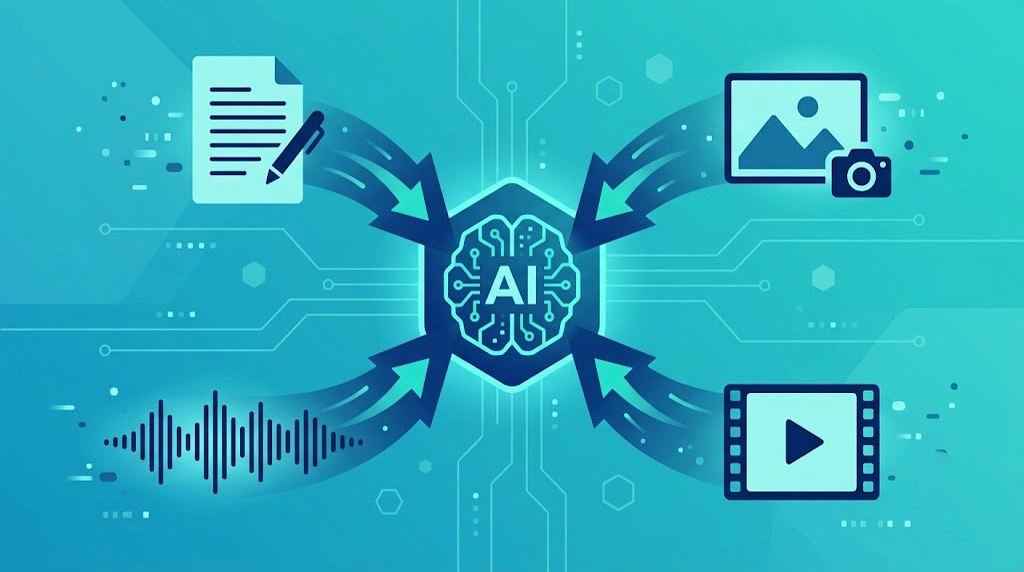
At its core, multimodal ai refers to artificial intelligence models capable of understanding and processing text, images, audio, and video together.
It bridges the gap between human communication and machine processing. Humans naturally process multiple types of information at once we listen to a speaker while looking at a presentation slide. A text image audio ai system replicates this exact behavior, allowing machines to synthesize context from a combination of different media formats.
To truly grasp this concept, we must differentiate it from older technologies. If you want a deeper dive into how machines generate content in general, review our guide on [What is Generative AI?].
How Multimodal AI Actually Works
You do not need to be a machine learning engineer to understand the mechanics behind multimodal models. However, knowing how they function helps you make better purchasing and operational decisions for your company.
To understand the mechanics, we must look at how these systems translate real-world data. Each input type—whether it is text, an image, audio, or video—gets converted into a shared numerical representation.
Turning Different Inputs Into a Shared Language
Think of a bustling international business hub like Dubai, where executives speak Arabic, English, and Mandarin. To collaborate perfectly, they need a universal translator. For multimodal ai, this universal translator is a mathematical concept called an embedding.
- The Conversion Process: When you upload a photo, the system does not “see” pixels the way a human eye does. It uses modality encoders to convert the visual data into a sequence of numbers.
- The Shared Space: When you type a text prompt, it also gets converted into numbers. The true magic happens because both the image numbers and the text numbers are mapped into the exact same shared space.
- The Output: Because all inputs are converted into this shared numerical language, the AI can reason across them. It connects the concept of a “truck” in your text to the visual shape of a truck in your image.
This is the foundation of modern vision language models. For a foundational look at how machines process visuals alone, see our article on [What is Computer Vision?].
What Multimodal AI Can Do Today
The business applications for multimodal ai are vast, especially in rapidly innovating regions like the GCC. To evaluate the ROI, it is critical to add a clear distinction between “multimodal input” and “multimodal output”.
Multimodal input means you give the AI an image, and it gives you text (like describing a photo). Multimodal output means you give the AI text, and it generates a brand new image or video. Let’s explore how text image audio ai combinations are transforming specific sectors.
Text + Image
The combination of text and image processing is the most mature application of multimodal models. AI image understanding allows businesses to automate visual inspections and data entry simultaneously.
- Retail and E-commerce: A marketing manager in Saudi Arabia can upload a raw product photo alongside rough listing text. The multimodal ai will analyze the product’s visual features and write a compelling, SEO-optimized product description.
- Industrial Maintenance: In the Qatari oil and gas sector, engineers can upload a photo of a corroded pipeline valve. The AI cross-references the visual damage with textual maintenance manuals to suggest immediate repair protocols.
If you are looking to integrate visual analysis into your workflows, explore the [Best AI for Image Analysis and Computer Vision].
Text + Audio
Combining text and audio goes far beyond simple transcription. Modern multimodal ai can detect tone, sentiment, and context from voice data.
- Customer Service Quality: Call centers in the UAE use these models to listen to customer support calls in real-time. The AI analyzes the audio tone (e.g., frustration) and the text transcript to guide the human agent on how to de-escalate the situation.
- Executive Summaries: Board meetings can be recorded and instantly transformed into structured action items. The AI listens to the audio, identifies different speakers, and outputs a formatted text document of strategic decisions.
Text + Video
Processing video is highly complex because it requires analyzing thousands of sequential images alongside an audio track.
- Security and Logistics: Port authorities can use multimodal ai to monitor CCTV feeds. If the system “sees” unauthorized movement and hears a specific alarm, it can automatically generate a text-based incident report for security teams.
- Content Marketing: Marketing teams can feed long-form video content into an AI and ask it to extract the most engaging 30 second clips for social media based on textual criteria.
For specific tools in this category, check out our guide on the [Best AI for Summarizing YouTube Videos].
Not All Models Are Multimodal the Same Way
A common misconception among business leaders is assuming that all AI platforms offer the exact same features. It is vital to be explicit that not all “AI models” are equally multimodal.
Some models handle images perfectly but completely fail when presented with audio or video. Furthermore, a model’s multimodal capability varies by model and by the specific pricing plan you subscribe to.
| Feature Capability | Text-Only Models | Basic Multimodal Models | Advanced Multimodal Models |
| Data Processing | Reads documents only | Reads text and basic images | Analyzes text, video, and audio |
| Business Use Case | Drafting emails | Analyzing charts/graphs | Real-time meeting analysis |
| Cost Profile | Low cost | Mid-tier subscription | Premium enterprise pricing |
| Example Utility | Summarizing reports | AI image understanding | Complex vision language models |
Before investing, you must audit your specific business needs. If your logistics company only needs to digitize handwritten delivery manifests, a basic vision model is sufficient. If you need to analyze drone video footage of a construction site, you need a premium, fully multimodal ai solution.
Real-World Examples of Multimodal AI at Work
To move beyond theory, let’s look at concrete multimodal models examples driving efficiency in the Middle East today.
- Real Estate in Dubai: Property developers use multimodal ai to accelerate sales. They feed the AI architectural blueprints (images) and local zoning laws (text). The AI then generates highly accurate, compliance-checked marketing brochures.
- Healthcare in Riyadh: Medical administrators utilize vision language models to streamline patient onboarding. The system scans a patient’s physical ID card (image) and verbally confirms their medical history (audio), compiling a secure text file for the doctor.
- Retail Supply Chain: Warehouse managers use multimodal ai to optimize inventory. By cross-referencing security camera feeds (video) with digital inventory logs (text), the system instantly flags discrepancies between what is physically on the shelf and what is recorded in the database.
These multimodal models examples highlight a simple truth: businesses that leverage multiple data streams simultaneously will significantly outpace competitors relying on manual, siloed data entry.
Frequently Asked Questions
To ensure you have a complete grasp of what is multimodal ai, here are answers to the most common questions asked by corporate decision-makers.
- What is multimodal ai in simple terms?
It is an artificial intelligence system that can “see, hear, and read.” It processes multiple types of data—like text, images, and audio—simultaneously to understand context better than a text-only system.
- What are vision language models?
Vision language models are a specific sub-category of multimodal systems. They are specifically trained to connect visual data (images) with natural language (text), enabling highly accurate AI image understanding.
- Does multimodal output cost more than text generation? A: Generally, yes. Generating an image or analyzing a long video requires significantly more computational power than simply generating a paragraph of text. This is why capability varies by model and by plan.
- Is real-time video analysis reliable for business operations? A: Not entirely. While technology is advancing rapidly, real-time video understanding is still inconsistent across models. It is best used for post-event analysis rather than mission-critical, split-second decision-making.
- Can a text image audio ai replace my data entry team?
It will not replace them; it will supercharge their productivity. A text image audio ai can automate the extraction of data from scanned invoices and voice memos, freeing your team to focus on strategic analysis and quality control.
Key Takeaways
Navigating the rapidly evolving world of artificial intelligence can feel overwhelming for business leaders. However, understanding the shift from text-only chatbots to robust multimodal models is the key to unlocking true operational efficiency. By leveraging systems that possess advanced AI image understanding, your organization can automate workflows that were previously deemed too complex for software.
As you evaluate your technology stack, remember that not every model handles every format equally well. To ensure you are making a data-driven investment, our [Lexika’s model comparison] makes it easy to see which model fits a specific multimodal task. Find the right tool for your specific business challenge, and start turning your unstructured data into a competitive advantage today.
