
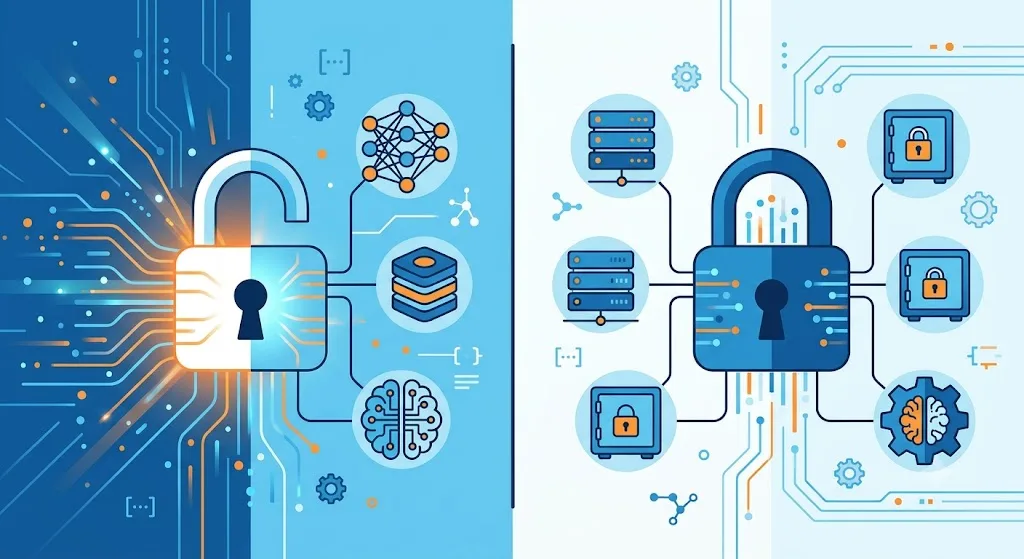
Artificial intelligence is rapidly and fundamentally transforming the corporate and industrial landscape across the Middle East. Whether you are a CTO tasked with automating complex supply chain logistics in Dubai, or a Marketing Director building a highly localized, Arabic-fluent customer service chatbot in Riyadh, the foundational choice of your underlying technology stack will dictate your organization’s long-term operational success. As a senior decision-maker, you are inevitably faced with one of the most critical infrastructural debates of this decade: open source vs closed source ai.
This is not merely a technical argument reserved for software engineers and developers; it is a profound strategic business decision. Your choice directly impacts your company’s data security protocols, your long-term operational budget, your flexibility, and your ultimate speed to market. Historically, there was a massive, undeniable performance gap between the two approaches, leading many executives to instinctively assume that “open source equals worse”. Today, in 2026, that assumption is dangerously outdated and financially irresponsible.
This comprehensive guide will break down the practical differences in plain English, explore the real-world trade-offs in performance and cost, and help you navigate the increasingly complex ecosystem of proprietary ai models and the rising wave of the modern open source LLM. If you are entirely new to this space and need to build a foundational understanding first, we highly recommend starting with our introductory guide, [What is Artificial Intelligence].
The Difference in One Sentence
To simplify the open source vs closed source ai debate, think of it this way: choosing open-source is like buying the detailed engine blueprints to build, modify, and maintain your own high-performance vehicle, whereas choosing closed-source is like paying a premium fare for a luxury taxi ride where a completely different company owns, drives, and maintains the vehicle on your behalf.
What “Open-Source AI” Actually Means
To accurately understand the value proposition, we must first define the terminology clearly and without unnecessary technical jargon. When industry professionals discuss an open source llm, it specifically means that the model’s underlying mathematical architecture and its weights are publicly available for anyone to access. (Weights are essentially the billions of mathematical parameters that dictate how the AI connects concepts and generates its intelligent responses.)
Because these assets are freely available, anyone can download these open weight models without paying licensing fees. You can run them securely on your own internal hardware, fine-tune them extensively using your proprietary corporate data, and integrate them seamlessly into your internal systems without ever asking for permission from a tech giant. For a deeper dive into the specific mechanics of how these systems process language, you can read [What is a Large Language Model (LLM)?].
Leading Examples: Meta’s highly popular Llama series, Europe’s Mistral, and Alibaba’s powerful Qwen are currently leading the global open-source market.
Key Business Advantages of Open-Source:
- Absolute Data Privacy and Sovereignty: If a major financial institution or government entity in Qatar deploys an open source llm on their private, air-gapped, on-premise servers, they guarantee that their highly sensitive customer data never leaves their physical building. This total control is the primary driver for adoption in highly regulated industries across the GCC.
- Deep, Unrestricted Customization: Because you have the blueprints, you can alter the model’s core behavior to act exactly as your business requires. You are completely free from the standard safety filters, tone restrictions, and usage limits imposed by public APIs. You dictate the rules.
- No Vendor Lock-In: When you build your infrastructure around open weight models, you are not at the mercy of a single Silicon Valley corporation. If a vendor changes their API pricing or sunsets a model you rely on, your business operations remain completely unaffected.
What “Closed-Source AI” Actually Means
Conversely, closed source ai models are entirely proprietary systems. The developing company (often referred to as the vendor) keeps the internal architecture, the mathematical weights, and the original training data strictly confidential and locked behind closed doors. As a business user or enterprise client, you cannot download, inspect, or independently verify the inner workings of the model.
Instead, you access these proprietary ai models exclusively through a user-friendly web interface (like the ChatGPT application) or by sending your data to the vendor’s API (Application Programming Interface).
Leading Examples: OpenAI’s GPT-4o, Anthropic’s Claude 3.5 Sonnet, and Google’s Gemini Advanced.
Key Business Advantages of Closed-Source:
- Zero Infrastructure Overhead: You do not need to purchase millions of dirhams worth of expensive GPU servers, nor do you need to hire a team of highly specialized DevOps engineers to host and maintain the model. You simply pay a predictable monthly subscription fee or a cost-per-token (essentially paying per word processed) to use it.
- Immediate Deployment and ROI: A marketing agency in Abu Dhabi can integrate a closed-source API into their content generation workflow in a single afternoon. They immediately tap into state-of-the-art global intelligence without any setup friction, accelerating their time to market.
- Continuous, Invisible Upgrades: The vendor handles all the maintenance. When a smarter, faster version of the AI is released, your API endpoint simply becomes smarter overnight, requiring zero manual updates from your IT department.
Performance: How Close Is the Gap Really?
For several years, the open source vs closed source ai debate was heavily skewed simply because closed models were exponentially smarter, faster, and more reliable. When analysts were discussing llama vs gpt open source comparisons just two or three years ago, GPT was the undisputed, unchallenged king of the industry. Choosing open-source meant accepting a massive downgrade in artificial intelligence capability.
Today, in 2026, the performance gap has narrowed significantly, and in some specific vertical sectors, it has vanished entirely.
The latest generation of open-source technology has achieved near-parity with premium closed models on standardized industry benchmarks. For instance, looking at the current landscape, massive open models like Llama 3 (the 400B parameter version) and Qwen 2.5 score remarkably close to models like GPT-4o on complex mathematical reasoning, sophisticated coding benchmarks (like SWE-bench), and multilingual comprehension tests.
However, corporate leaders must understand that parity on a standardized benchmark test does not always equal parity in real-world, localized business deployment. While a massive open-source model might match a proprietary API in raw reasoning capabilities, running that massive open model requires incredibly expensive, specialized hardware.
If you want to see exactly how these open alternatives stack up against each other in practical scenarios, review our dedicated deep-dive comparisons: [Qwen vs Llama] and [Mistral vs Llama].
Cost: The Real Math, Not Just Price-Per-Token
When C-level leaders compare open source vs closed source ai, they frequently fall into a dangerous financial trap regarding long-term cost. Because downloading the code for an open-source model is technically “free,” there is a widespread, flawed assumption that it is inherently the cheaper route.
This is fundamentally incorrect for most standard enterprise deployments. We must be completely honest and transparent: self-hosting an open-source model has very real, very heavy infrastructure and engineering costs. It is absolutely not “free” in practice.
The True Cost of Closed-Source AI
With closed source ai models, your corporate pricing is highly predictable and purely operational. You pay per token (roughly per word) that is processed by the API.
- The Financial Pros: You only pay for exactly what you use. There are zero ongoing maintenance costs, zero physical server costs, and zero downtime events for your internal IT team to manage. It shifts AI from a massive Capital Expenditure (CapEx) to a predictable Operating Expense (OpEx).
- The Financial Cons: At a truly massive, enterprise scale (for example, if your application is processing millions of customer support transcripts daily), the API usage costs can quickly become astronomical. Furthermore, you are completely locked into the vendor’s pricing strategy; if they decide to raise their API prices by 20% next quarter, your operational costs increase immediately, and you have little recourse.
The True Cost of Open-Source AI
With open-source technology, the software itself is completely free to download, but the specialized hardware required to run it is exceptionally expensive.
- The Financial Pros: The per-token generation cost is effectively zero once your infrastructure is fully built and operational. At an extreme, enterprise scale, owning the hardware infrastructure becomes significantly cheaper over a multi-year horizon than paying a continuous 50% profit margin to an API vendor.
- The Financial Cons: To run a leading, state-of-the-art model at acceptable commercial speeds, you need arrays of highly expensive GPU servers (which currently face massive global supply chain shortages). Furthermore, you cannot just plug in a server; you must hire highly salaried, specialized Machine Learning (MLOps) engineers to maintain, update, patch, and secure the deployment.
To understand which specific open models are actually viable for your business deployment without breaking your IT budget, read our comprehensive guide on the [Best Open-Source AI for Commercial Use].
Which One Is Right for You?
The final resolution to the open source vs closed source ai debate cannot be found in a generic whitepaper; it lies entirely in your company’s specific business requirements, regulatory environment, and technical capabilities. Let’s look at two contrasting, concrete scenarios to make the decision framework perfectly clear.
Scenario A: When Open-Source Makes Perfect Sense
Imagine a major, multi-national healthcare provider headquartered in Saudi Arabia. They possess millions of highly sensitive, confidential patient medical records that they want to use to train a localized, AI-driven diagnostic assistant for their doctors.
Due to extremely strict GCC data residency laws, patient privacy regulations, and internal corporate compliance mandates, this sensitive medical data absolutely cannot leave their private servers. It certainly cannot be sent over the public internet to a US-based commercial API. For this healthcare organization, utilizing proprietary ai models is immediately and legally disqualified.
They must download an open-source model, host it securely on their own internal, air-gapped servers, and willingly absorb the high initial infrastructure costs. In this scenario, they are trading high setup costs for total data sovereignty, security, and legal compliance.
Scenario B: When Closed-Source Makes Perfect Sense
Now, consider a highly agile, mid-sized e-commerce startup based in the UAE. They want to launch an intelligent, multilingual customer service chatbot before the upcoming massive holiday retail season. They have a small, lean development team and a strictly capped operational budget.
This startup wants the fastest possible product launch with absolutely no infrastructure overhead. Attempting to procure GPU servers, configuring the hosting environment, and hiring an ML engineer to deploy an open model would take them six months and cost hundreds of thousands of dirhams.
Instead, their lean development team integrates a closed-source API (like OpenAI or Anthropic) in just three days. They pay only a few hundred dollars a month based strictly on their actual seasonal usage. For this startup, the sheer speed, convenience, and low barrier to entry of closed source ai models make it the undisputed, clear winner.
Frequently Asked Questions
To ensure absolute clarity on this complex infrastructural topic, here are the answers to the most common questions we receive from corporate decision-makers regarding the open source vs closed source ai debate.
Are open-source models completely free to use for my business?
The model weights (the actual software files) are usually free to download. However, hosting them so your employees can actually use them requires significant computational power (expensive GPUs) and engineering talent, which can represent a massive financial investment for your IT department.
Is the llama vs gpt open source comparison still a valid debate today?
Absolutely. In the ongoing llama vs gpt open source debate, Meta’s latest Llama models are now highly competitive with OpenAI’s GPT models, particularly in the smaller parameter sizes that are most suitable for standard, everyday business tasks like summarization and data extraction.
Which technological route is generally considered more secure, proprietary ai models or open source?
Open source is widely considered more secure for highly sensitive, proprietary corporate data because you can host the model locally on your own internal network. This ensures your confidential data never travels across the public internet to be processed by a third-party API vendor.
What is the main disadvantage of relying entirely on proprietary ai models?
The primary disadvantages are vendor lock-in and a lack of data privacy control. You are entirely dependent on the vendor’s pricing models, their server uptime, and their corporate data policies. If their servers go offline, your business automation goes offline.
Can I use any of these open weight models for commercial, for-profit purposes?
Most modern open models (like the Llama 3 series) do allow commercial use, but you must carefully read the specific licensing agreement. Some models include strict restrictions on massive-scale commercial deployment (e.g., if your app reaches over 700 million active users, you must request a special license).
Key Takeaways
Navigating the complex transition into an AI-first business model can feel overwhelming, but understanding the foundational difference between open source vs closed source ai ensures you build your enterprise on the right infrastructure. Do not get caught up in the social media hype of technologists claiming one approach is universally better than the other. The right choice depends entirely on your specific regulatory environment in the GCC, your engineering capacity, and your operational budget.
Whichever direction fits your highly specific business needs, [Lexika gives you access to both proprietary and leading open-source models] in one unified place, without needing to host anything yourself. Stop worrying about complex infrastructure management and start driving immediate, measurable ROI with the best models the global market has to offer.
