

Machine Learning (ML) is a powerful subset of Artificial Intelligence (AI) that enables computer systems to learn from data without being explicitly programmed. Much like how children learn through experience, ML algorithms identify patterns in data to make predictions or decisions. This capability is transforming businesses across the GCC by enabling smarter automation, personalized customer experiences, advanced data analysis, and innovative product development, ultimately driving efficiency and growth.
What is Machine Learning and why is it Changing Business
In the rapidly evolving world of technology, you’re constantly hearing about Artificial Intelligence (AI). But a crucial component driving much of AI’s power is Machine Learning (ML). So, what is Machine Learning? Think of it as teaching computers to learn from experience, much like how children learn. Instead of relying on rigid, pre-programmed instructions for every possible scenario, ML allows computers to analyze vast amounts of data, identify patterns within it, and then use those patterns to make predictions or decisions about new, unseen data. This ability to learn and adapt is revolutionizing industries, offering businesses in the GCC unprecedented opportunities for innovation, efficiency, and deeper customer understanding.
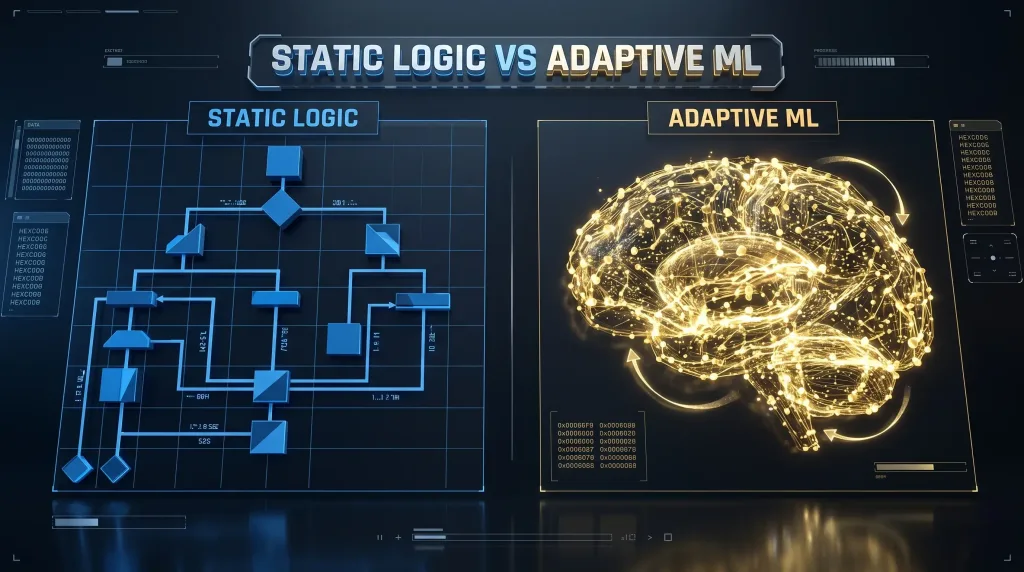
Traditional Programming vs. Machine Learning
| Traditional Programming | Machine Learning |
|---|---|
| Relies on explicit, step-by-step instructions written by developers to define how a task should be performed. | Learns patterns and rules directly from data, without requiring explicit instructions for every scenario. |
| Follows rigid rules; the system behaves only as programmed (e.g., “if keyword X appears, mark as spam”). | Adapts and generalizes from examples, enabling it to make predictions about new, unseen data. |
| Requires manual updates whenever new cases or exceptions arise. | Automatically improves with more data, becoming more accurate over time. |
| Limited in handling complex or ambiguous tasks due to rule-based constraints. | Excels in complex, noisy, or unstructured environments by learning from large datasets. |
How Machine Learning Works: The Power of Data and Algorithms
At its core, Machine Learning involves training computers using data. This process generally follows these steps:
- Data Collection: Gathering relevant data is the first crucial step. The quality and quantity of this data directly impact the performance of the ML model. For a business, this could be customer purchase history, website interaction logs, sensor readings from machinery, or market trends.
- Data Preparation: Raw data often needs cleaning, formatting, and structuring before it can be used for training. This might involve removing errors, handling missing values, or transforming data into a suitable format.
- Choosing a Model: There are various types of ML learning algorithms, each suited for different tasks:
- Supervised Learning: The algorithm is trained on labeled data (e.g., emails labeled as spam/not spam). It learns to map inputs to outputs. This is used for tasks like classification (e.g., identifying fraudulent transactions) and regression (e.g., predicting house prices).
- Unsupervised Learning: The algorithm is given unlabeled data and must find patterns or structures on its own. This is useful for tasks like customer segmentation (grouping customers with similar behaviors) or anomaly detection (finding unusual patterns).
- Reinforcement Learning: The algorithm learns through trial and error, receiving rewards or penalties for its actions. This is often used in robotics and game playing.
- Training the Model: The chosen algorithm is fed the prepared data. It iteratively adjusts its internal parameters to better capture the patterns within the data, essentially “learning” from the examples.
- Evaluation: After training, the model’s performance is tested on a separate dataset (which it hasn’t seen during training) to assess its accuracy and effectiveness.
Deployment: Once validated, the trained ML model can be deployed into a real-world application to make predictions or decisions on new data.

Deep Learning: A Powerful Subset of Machine Learning
A particularly exciting area within ML is Deep Learning. Deep Learning utilizes artificial neural networks with multiple layers (hence “deep”) to learn complex patterns from vast amounts of data. These multi-layered networks allow DL models to automatically learn features from raw data, often eliminating the need for manual feature engineering. This is the technology behind many recent AI breakthroughs, including advanced image recognition, natural language processing (like LLMs), and sophisticated recommendation systems.
Machine Learning in Action: Driving Business Value in the GCC
The practical applications of ML are transforming businesses across the Gulf region:
- Personalized Customer Experiences: E-commerce platforms and retail businesses in Dubai and Riyadh use ML to analyze customer behavior, predict purchasing patterns, and offer personalized product recommendations, significantly boosting sales and customer loyalty.
- Predictive Maintenance: In the oil and gas sector of Saudi Arabia and Qatar, ML algorithms analyze sensor data from equipment to predict potential failures before they occur. This proactive approach minimizes costly downtime and enhances operational safety.
- Fraud Detection: Financial institutions across the GCC employ ML models to analyze transaction data in real-time, identifying and flagging suspicious activities with high accuracy, thereby protecting both the institution and its customers.
- Process Optimization: ML can optimize complex logistical operations, supply chains, and energy consumption by analyzing vast datasets to identify inefficiencies and suggest improvements, leading to substantial cost savings.
- Data Mining and Insights: ML techniques are invaluable for data mining, allowing businesses to uncover hidden trends, correlations, and insights within their data that might otherwise go unnoticed, informing strategic decision-making.
- According to recent McKinsey research, generative AI and Machine Learning could add between 20billionand50 billion in annual economic value to the Middle East by 2030, driven largely by productivity improvements and automation. Gartner also highlights that AI-driven analytics and automation could increase operational efficiency in GCC enterprises by up to 30% over the next few years. These gains are particularly pronounced in sectors like oil and gas—where ML models analyze seismic data, drilling logs, and equipment telemetry—and in major regional logistics hubs, where ML optimizes cargo flows, customs processing, and port operations across Saudi Arabia, the UAE, and Qatar.

Embracing Machine Learning for Future Growth
Understanding what is machine learning is no longer just for technical experts; it’s becoming essential for business leaders aiming to stay competitive. By leveraging learning algorithms and the power of data mining, companies can:
- Enhance Operational Efficiency: Automate complex tasks and optimize resource allocation.
- Improve Decision-Making: Gain deeper insights from data to make more informed strategic choices.
- Create Better Customer Experiences: Offer personalized products, services, and support.
- Drive Innovation: Develop new AI-powered products and services that meet evolving market demands.
A Foundation for Intelligent Business: “The future belongs to those who believe in the beauty of their dreams.” – Eleanor Roosevelt This inspirational quote underscores the vision required to embrace transformative technologies like Machine Learning. By learning from data and adapting, ML empowers businesses to build smarter operations and realize their future aspirations.
Unlock Your Business Potential with Machine Learning
Machine Learning is no longer a futuristic concept; it’s a present-day engine for business transformation. Understanding its capabilities and how it differs from traditional programming is vital for any organization aiming to thrive in the data-driven economy of the GCC.
Simplify your adoption of AI. Discover how you can leverage the power of machine learning and other advanced AI models through a unified, user-friendly platform.
Learn More About lexika’s Solutions
Frequently Asked Questions (FAQ)
What is the simplest way to understand Machine Learning?
Machine Learning is about training computers to learn from data, similar to how children learn from experience, without being explicitly programmed for every task.
Is Deep Learning the same as Machine Learning?
Deep Learning is a specialized subset of Machine Learning that uses complex, multi-layered neural networks to learn from data, often achieving state-of-the-art results in areas like image and speech recognition.
How does ML help with data analysis in business?
ML algorithms are crucial for data mining, enabling businesses to uncover hidden patterns, trends, and insights from large datasets, which informs better decision-making and strategy.
Do I need to be a programmer to use ML?
While understanding ML principles is beneficial, many platforms now offer user-friendly tools and pre-built learning algorithms that allow businesses to implement ML solutions without extensive programming knowledge. Exploring solutions like those on lexika’s Pricing page can show you accessible options.
How can my business in the UAE or Saudi Arabia benefit from ML today?
ML can enhance customer personalization, optimize logistics, improve fraud detection in finance, enable predictive maintenance in industry, and provide deeper data insights for strategic planning.
Can ML models work effectively with Arabic datasets common in GCC industries?
Yes. Modern ML models can be trained or fine-tuned on Arabic datasets—including Gulf dialect data—to achieve strong accuracy. Domain-specific tuning (finance, logistics, oil and gas) further improves performance in real-world GCC applications.
How long does it take to implement a Machine Learning solution in a business?
Timelines vary based on data readiness and complexity, but many ML projects can begin delivering value within weeks. Cloud-based tools and pre-trained models significantly speed up deployment for organizations in Saudi Arabia and the UAE.
Does Machine Learning require a large amount of data to be useful?
While more data typically improves performance, many ML approaches can work well even with moderate datasets—especially when combined with transfer learning or pre-trained models. High-quality, well-structured data is more important than large volumes.