

In today’s dynamic business environment, understanding the core of Artificial Intelligence (AI) is essential, especially for leaders in the GCC region. Neural networks, inspired by the human brain’s structure, are key to this understanding. They enable systems to learn from data and make intelligent decisions, driving innovation and efficiency. This article demystifies neural networks, explaining their function and relevance for your business.
Executive Summary
• Neural networks mimic the structure of the human brain, enabling AI systems to learn patterns, make predictions, and continuously improve through data.
• Deep learning—built on multi-layer neural networks—drives major breakthroughs in computer vision, NLP, and personalization technologies used across modern GCC industries.
• Businesses in the Gulf region are leveraging neural networks to boost customer insights, optimize operations, enhance analytics, and achieve measurable improvements in efficiency and ROI.

Artificial Neurons: The Brain’s Building Blocks
The foundation of any neural network is the artificial neuron (or node), which simulates the biological neurons in our brains.
- Inputs: Neurons receive signals.
- Weights: Each input has a weight, signifying its importance. These weights are adjusted during the learning process.
- Bias: A bias term acts like a threshold, influencing the neuron’s activation.
- Activation Function: This function determines if a neuron fires and what its output signal will be, introducing necessary non linearity.
Layers of Intelligence: Processing Information
Neural networks are organized into layers to process information hierarchically:
- Input Layer: Receives raw data (e.g., features of a product, customer data). Each neuron represents a data feature.
- Hidden Layers: Located between the input and output layers, these layers transform data into more abstract representations. Networks with multiple hidden layers form the basis of deep learning, enabling the identification of complex patterns.
- Output Layer: Produces the final result or prediction, with the number of neurons depending on the task (e.g., classification or regression).
Learning from Data: The Training Process
Neural networks learn through a training process that adjusts weights and biases to minimize prediction errors.
- Forward Propagation: Input data travels through the network to generate a prediction.
- Error Calculation: The prediction is compared to the actual outcome to calculate the error.
- Backpropagation: The error is sent backward through the network. Algorithms like gradient descent determine how each weight and bias contributed to the error.
- Weight Update: Weights and biases are adjusted to reduce the error. This cycle repeats millions of times, enabling the network to generalize and make accurate predictions on new data.
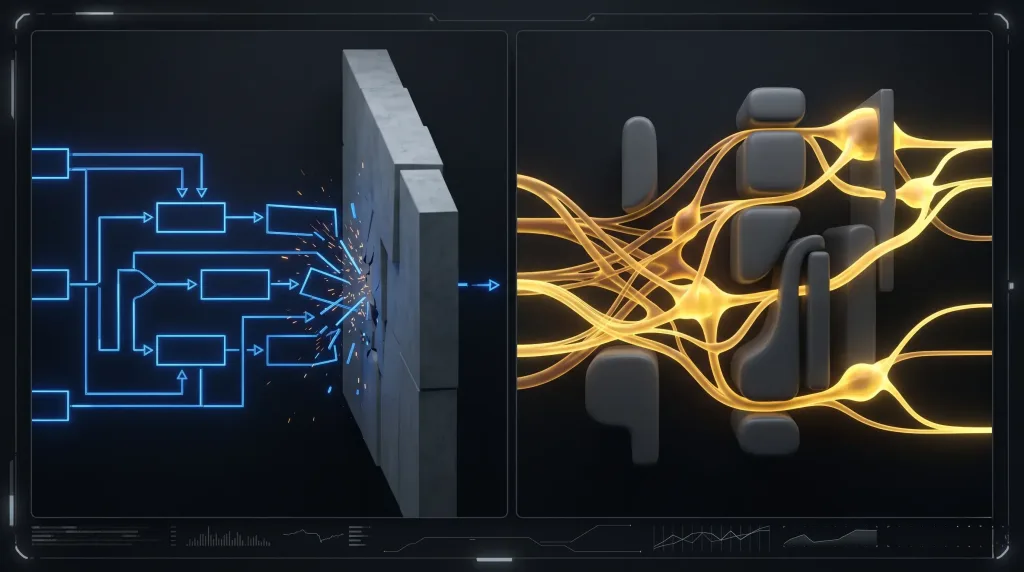
Deep Learning: The Power of Depth
Deep learning utilizes neural networks with numerous hidden layers (deep neural networks). This depth allows them to automatically learn complex, hierarchical data representations. This has driven breakthroughs in:
- Computer Vision: Enabling machines to interpret images and videos.
- Natural Language Processing (NLP): Facilitating understanding and generation of human language.
- Recommendation Systems: Powering personalized suggestions across platforms.
Simple Neural Networks vs. Deep Learning
| Simple Neural Networks | Deep Learning (Deep Neural Networks) |
|---|---|
| Contain only a few hidden layers, making them easier to understand and computationally lighter. | Consist of many hidden layers, enabling hierarchical representation learning. |
| Handle basic or moderately complex tasks such as simple classification or regression. | Excel at highly complex tasks like image recognition, speech processing, and advanced NLP. |
| Require manual feature extraction; performance depends heavily on engineered inputs. | Automatically learn relevant features from raw data, reducing the need for manual feature engineering. |
| Suitable for small datasets and quick training. | Require large datasets and more computational power but deliver significantly higher accuracy. |
| Limited ability to identify deep or abstract patterns in data. | Capable of capturing highly abstract relationships and multi-level patterns. |
Neural Networks in Business: Driving ROI in the GCC
Neural networks offer tangible benefits for businesses in the GCC:
- Enhanced Customer Insights: Analyzing customer data helps predict needs, segment audiences, and personalize marketing, boosting بretention and sales in competitive markets like the UAE.
- Optimized Operations: In logistics and manufacturing, they can forecast demand, optimize supply chains, and enable predictive maintenance, reducing costs in regions like Saudi Arabia and Qatar.
- Advanced Analytics: Sectors like finance and energy use them for fraud detection, risk assessment, and resource optimization.
- Personalized User Experiences: Tailoring content and recommendations improves user engagement.
According to PwC’s Middle East AI Outlook, artificial intelligence—including neural-network-driven systems—could contribute over $320 billion to the region’s economy by 2030, with Saudi Arabia and the UAE capturing the largest share of this growth. McKinsey similarly notes that AI-powered automation and analytics could boost productivity across key sectors such as energy, logistics, and financial services by 20–40%. For GCC businesses, neural networks play a central role in unlocking this value: from enhancing refinery optimization in the energy sector to accelerating port logistics and enabling intelligent forecasting models that directly impact profitability and operational resilience.
Conclusion: Intelligent Systems for Future Growth
Neural networks, inspired by the human brain, provide powerful capabilities for learning, adaptation, and problem-solving. For GCC businesses aiming for growth and efficiency, understanding and implementing neural networks is becoming essential.

Ready to leverage AI for your business?
Don’t let complexity be a barrier. lexika offers a unified platform to seamlessly integrate advanced AI models, including neural networks, into your operations.
Discover lexika’s AI Solutions and start your transformation today.
Frequently Asked Questions (FAQ)
Is a neural network a type of AI?
Yes, neural networks are a subset of machine learning, a core part of Artificial Intelligence.
What’s the difference between a neural network and deep learning?
Deep learning involves neural networks with multiple hidden layers, enabling more complex pattern recognition.
How do neural networks learn?
They learn by training on large datasets, adjusting weights and biases through algorithms like backpropagation to minimize prediction errors.
Can neural networks be used for simple tasks?
Yes, simpler networks can handle basic tasks, but their strength lies in complex pattern recognition.
How can businesses leverage neural networks without deep technical expertise?
Platforms like lexika offer managed services and user friendly interfaces, making advanced AI accessible. Explore our Pricing Page for more information.