
Executive Summary
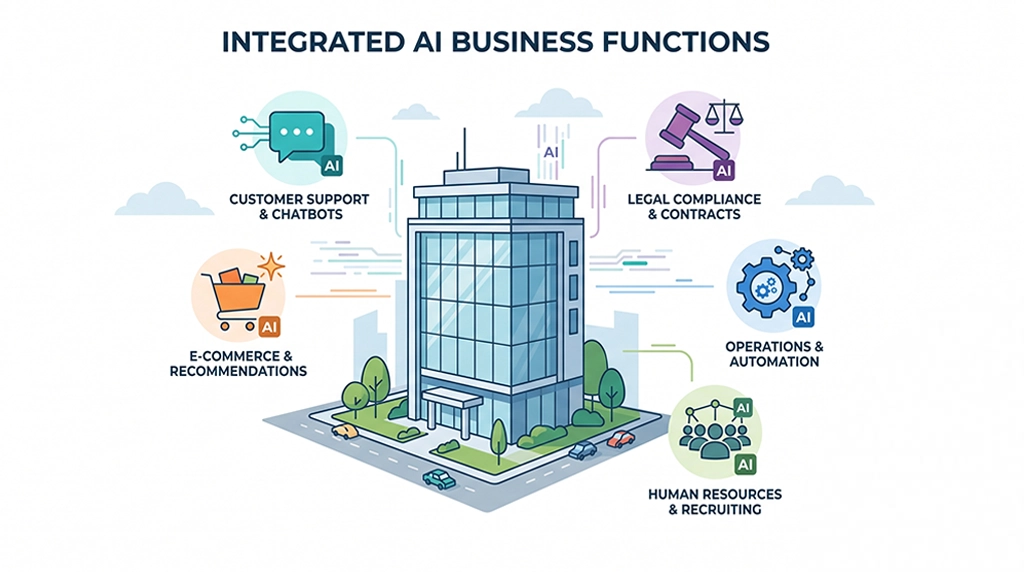
In 2026, implementing ai for business has transitioned from an experimental tech play to a strict operational necessity for driving profit margins and simplifying overhead. Rather than deploying massive, single-track setups, modern enterprises are utilizing agentic ai for business alongside hyper-focused model distribution. From optimizing customer support in Dubai’s retail market to automating legal compliance in Riyadh’s financial sector, success is defined by a pragmatic formula: technology represents only 20% of the puzzle, while 80% is driven by strategic workflow redesign.
To scale efficiently without being locked into a single software ecosystem, teams are moving away from single-vendor subscriptions. Instead, they are integrating unified workspaces to access the best models for each distinct corporate task.
The State of Business AI Adoption in 2026
The landscape of enterprise ai applications has matured into an essential layer of modern corporate infrastructure. According to the Deloitte State of AI in the Enterprise 2026 report, overall global adoption has crossed critical thresholds, with over 78% of enterprise-level firms officially integrating cognitive modeling into their daily production workflows. Regional data from McKinsey echoes this transformation, revealing that corporate entities across the GCC—particularly in Saudi Arabia and the UAE—are heavily prioritizing generative investments to combat rising operational costs and support localization initiatives.
Rather than just relying on generic text-generation chat windows, modern business ai use cases are dominated by autonomous agents. These systems can access private internal files, use third-party software tools, and complete multi-step tasks with minimal human intervention.
When looking closely at the ai adoption statistics 2026 introduces, the most successful implementations are those that balance structural risk with direct, measurable return on investment (ROI).
AI Governance in 2026
Enterprise technology planning must account for global compliance standards. The European Union AI Act’s tiered risk requirements officially take effect on August 2, 2026, establishing strict, legally binding operational standards for models processing user data—a framework that is rapidly becoming the global template for local compliance policies across the Middle East.
AI for Customer Support & Service
One of the most immediate, high-yield business ai use cases is customer support. Historically, customer support chatbots relied on rigid, pre-programmed rule trees that left users frustrated and required frequent human intervention.
In 2026, agentic ai for business has completely transformed customer support. Modern cognitive systems understand natural human phrasing, read customer intent, and integrate directly with localized CRM platforms.
This enables them to instantly look up shipping databases, process refund requests within regional guidelines, and update shipping details—all in real time and without requiring human staff.
Realistic ROI & Business Case
- The Numbers: Organizations deploying advanced cognitive agents for high-volume customer service report an average 40% reduction in customer service costs alongside a significant boost in first-contact resolution rates.
- GCC Context: A prominent luxury retailer in Dubai integrated an intelligent multi-language support agent to handle bulk inquiries in both Arabic and English. The system resolved over 75% of routine delivery queries without human intervention, allowing the company’s human concierge team to focus entirely on high-value VIP client relations.
If your team is looking to transform its customer service pipelines, explore our comprehensive guide on setting up shared collaborative environments in [team collaboration with Al].
AI for Marketing & Content
In the marketing sector, the initial novelty of using simple prompts to draft generic social media copy has evolved into highly structured, automated campaign development. Modern marketing departments use enterprise ai applications to run deep customer research, personalize outreach at scale, and manage complex cross-channel campaigns.
Rather than utilizing a single generic platform, teams use specialized systems for different creative tasks. This involves using high-reasoning models to draft deep strategy proposals, using fast, specialized systems to analyze web data, and deploying visual generators to produce localized marketing assets.
Realistic ROI & Business Case
- The Numbers: According to regional marketing audits, deploying specialized generative workflows can reduce content production times by over 60% while improving campaign click-through rates through hyper-personalized user segmentation.
- GCC Context: A major real estate development group in Abu Dhabi used high-reasoning models to draft hyper-localized property descriptions tailored to different buyer segments across the GCC, cutting down their creative production time from several days to a few minutes.
To learn how to deploy these workflows within your own brand department, read our vertical guide on [Al for marketing teams].
AI for HR & People Operations
Human Resources departments are heavily leveraging ai for business to streamline recruitment, optimize employee onboarding, and automate routine administrative tasks. This allows HR professionals to shift their focus from time-consuming paperwork to strategic talent development and employee retention.
In 2026, enterprise ai applications help HR teams parse thousands of candidate resumes, rank applicants based on objective skills, and draft highly customized onboarding curricula tailored to specific roles.
Realistic ROI & Business Case
- The Numbers: HR departments utilizing automated screening pipelines report a 50% decrease in overall time-to-hire, helping businesses secure top talent quickly in highly competitive regional job markets.
- GCC Context: A large logistics operator in Saudi Arabia implemented automated screening models to parse thousands of technical resumes during a rapid expansion, saving their HR team hundreds of hours of manual labor and ensuring complete compliance with local hiring policies.
To see how modern human resource teams are implementing these strategies, read our deep dive on [Al in HR].
AI for Legal & Compliance
Legal teams are experiencing some of the highest recorded returns on investment by integrating specialized, high-reasoning ai in industry workflows. Legal review is historically labor-intensive, requiring senior legal experts to spend hundreds of hours manually parsing dense documents.
Modern legal systems use advanced ai for business tools to instantly analyze multi-page agreements, flag non-standard liability clauses, and draft standardized compliance reports.
Realistic ROI & Business Case
- The Numbers: Case studies show that automated contract analysis can speed up contract review times by up to 70% while reducing regulatory compliance errors.
- GCC Context: A prominent financial institution in Riyadh deployed a specialized contract review pipeline to audit complex, cross-border commercial transactions, significantly accelerating their deal cycles while maintaining full regulatory compliance.
For a step-by-step breakdown of how to integrate these advanced legal tools, read our specialized resource on [legal team workflows].
AI for E-Commerce & Retail
In the fast-moving retail sector, ai for business is being used to build highly personalized shopping experiences, predict inventory needs, and dynamically optimize product pricing.
Rather than relying on static recommendation algorithms, modern e-commerce platforms use agentic ai for business to analyze user behavior in real time, customize product displays, and draft targeted follow-up offers based on individual shopping habits.
Realistic ROI & Business Case
- The Numbers: Retail brands utilizing advanced personalization models report an average 15% increase in average order value and a 20% boost in customer retention.
- GCC Context: An online fashion brand operating across the GCC implemented an automated personalization engine to customize search results and product recommendations, resulting in a direct boost to their conversion rates.
To learn more about optimizing your online sales channels, check out our guide on [e-commerce use cases].
AI for Operations, Finance & Manufacturing
Industrial sectors are utilizing ai in industry applications to optimize supply chains, automate routine accounting, and predict equipment maintenance needs before costly failures occur.
By analyzing data from factory sensors and logistics databases, predictive systems can flag anomalies early, preventing operational downtime and helping businesses save millions in unnecessary repairs.
Realistic ROI & Business Case
- The Numbers: Manufacturing plants deploying predictive maintenance systems report up to a 30% reduction in maintenance costs and a 45% decrease in unexpected equipment downtime.
- GCC Context: An energy infrastructure firm in Saudi Arabia integrated predictive models to monitor pipeline sensors, helping their operations team spot potential faults early and avoid expensive emergency shutdowns.
What’s Actually Driving ROI (and What Isn’t)
As businesses expand their investments in ai for business, a clear division has emerged between companies achieving massive, measurable returns and those draining their IT budgets on unproductive setups.
To help your team maximize its return, consider the major differences between high-ROI and low-ROI strategies:
| High-ROI Strategies (What Works) | Low-ROI Strategies (What Fails) |
| Workflow-First Focus: Redesigning operational processes around AI capabilities (the 80/20 rule). | Tech-First Focus: Buying expensive software licenses without updating team workflows. |
| Model Diversity: Matching individual tasks to the most cost-effective model for the job. | Single-Vendor Lock-In: Forcing a single model to handle every corporate task. |
| Task Automation: Automating repetitive, time-consuming tasks to free up human staff. | Broad Experimentation: Running endless pilot projects without clear goals. |
The most common point of failure for enterprise integration is ignoring the 80/20 rule of digital transformation: technology itself only represents 20% of the value, while the remaining 80% comes from redesigning workflows and training your team to use the tools effectively.
Choosing AI Tools for Your Team
When selecting ai for business tools, organizations often fall into the trap of purchasing separate subscriptions for every department.
Your marketing team wants premium Claude access for copywriting, your development team requests specialized coding tools, and your HR department demands separate data-sorting software. This creates disjointed data silos, introduces security risks, and leads to runaway software costs.
The most efficient way to manage this challenge is to implement a unified team environment that gives your staff access to the best models from a single, shared workspace.
This dynamic approach ensures your team always has the optimal tool for any task—whether it’s writing, coding, or data analysis—while consolidating your corporate billing and simplifying IT management.
Key Takeaways
- Focus on workflow redesign: Technology represents only 20% of the puzzle; the real business value comes from updating your team’s processes to work alongside AI.
- Avoid single-vendor lock-in: No single model excels at everything. A multi-model strategy allows your business to use the best tool for each specific job.
- Agentic workflows are the standard: Business applications have moved beyond simple text prompts to autonomous agents that can execute complex, multi-step tasks.
- Consolidate your tools: Juggling separate subscriptions creates security risks and unpredictable IT spending. Using a unified team workspace keeps your operations streamlined and cost-effective.
FAQs
How does the EU AI Act impact GCC-based businesses?
While the EU AI Act is a European regulation, its strict compliance guidelines officially taking effect on August 2, 2026, apply to any model processing the data of European citizens. Because many global enterprises in the UAE and Saudi Arabia operate internationally, these guidelines are rapidly becoming the standard for regional data privacy policies.
What is the primary difference between standard AI and agentic AI?
Standard AI models are reactive, requiring a human user to enter a prompt for every individual output. Agentic ai for business platforms are proactive; they can understand a high-level goal, break it down into steps, and use external tools and databases to complete complex tasks autonomously.
Why is a multi-model strategy better than using a single model?
No single model is the best at everything. While one model might excel at creative writing, another is faster at coding, and a third is more cost-effective for simple data extraction. A multi-model strategy ensures you always use the most capable and cost-effective system for each distinct task.
How do I protect our sensitive corporate data when using these systems?
To secure your data, avoid sending confidential records through public consumer tools. Instead, utilize enterprise-grade platforms that offer strict data privacy guarantees, or run open-source models on your own secure regional cloud servers.
Optimize Your Team’s AI Workflows Today
Stop overpaying for a patchwork of separate software licenses and trying to force a single model to handle all your business needs.
With Lexika’s unified workspace, your team can access the world’s leading models—including Claude, GPT, and Gemini—from a single, secure environment. [Compare these models side-by-side instantly start exploring on Lexika.] Lower your technology costs, protect your data privacy, and streamline your operations today.