

A chatbot is a sophisticated software application designed to simulate human conversation through text or voice commands. In today’s digital economy, especially across the GCC, chatbots have transitioned from simple, rule-based “answering robots” to advanced virtual assistants powered by conversational AI. For businesses in Dubai, Riyadh, and beyond, these tools offer a way to automate customer service, provide smart support 24/7, and significantly reduce operational costs while improving the customer experience (CX).
Understanding the Basics: What is a Chatbot?
So, what is a chatbot, exactly? At its core, it is a software application designed to simulate human conversation through text or voice. However, modern chatbots have evolved from simple, frustrating answering robots into intelligent virtual assistants that provide 24/7 smart support. In this guide, we will break down how they work, the different types of chatbots, and how they can revolutionize your customer service.
For a long time, business owners viewed chatbots as those annoying “press 1 for English” menus or basic pop-ups that couldn’t answer a single complex question. But thanks to the rise of Large Language Models (LLMs), the modern answering robot is now capable of understanding intent, sentiment, and even local cultural nuances in the Middle East market.

Evolution of Support: From Menus to Conversational AI
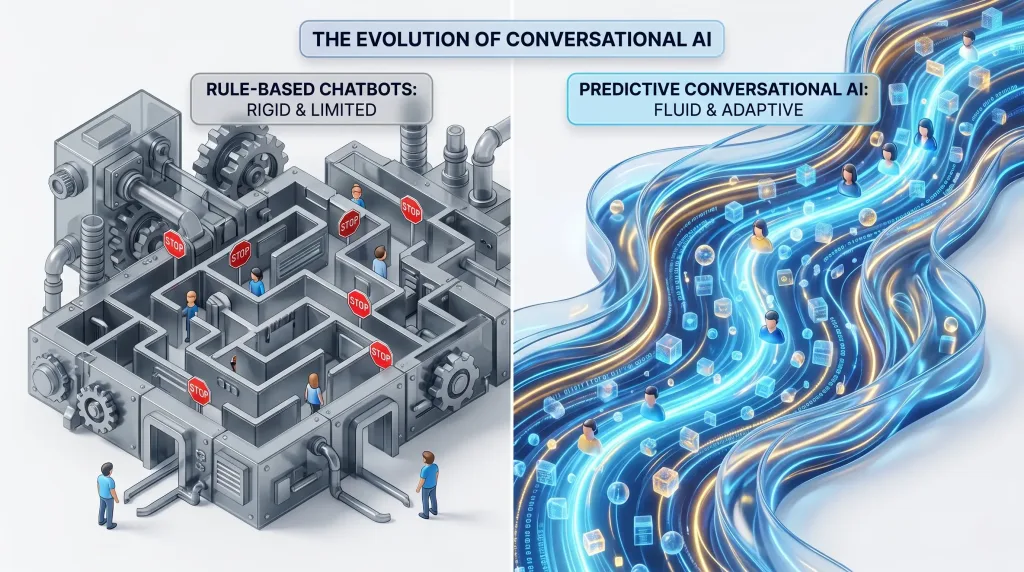
The fundamental difference between traditional support and modern AI lies in the brain of the bot. To understand the landscape, we have to look at the two primary categories:
- Rule-Based (Declarative) Chatbots:
These are the most basic types. They follow a strict set of “if/then” rules. If you ask a question outside of their pre-programmed script, they fail. They are great for simple tasks like checking an order status but aren’t truly smart.
- AI-Powered (Predictive) Chatbots:
This is where conversational AI comes in. These bots use machine learning to understand the meaning behind your words. Instead of looking for keywords, they analyze the context. This allows them to act as a true virtual assistant, handling complex inquiries like “Can you suggest a gift for my partner under 500 AED?”
How Chatbots Drive Business Value in the GCC
In regions like the UAE and Saudi Arabia, where digital transformation is moving at lightning speed, chatbots are no longer optional. They are strategic assets. Here is how they are changing the game:
- 24/7 Smart Support: In a global market, customers don’t wait for business hours. An AI bot can handle a query at 3 AM in Riyadh just as easily as at 10 AM in London.
- Cost Efficiency: By choosing to automate customer service, companies can handle thousands of queries simultaneously without hiring a massive call center.
- Personalization at Scale: Modern bots can integrate with your CRM to greet customers by name and suggest products based on their past purchase history in Dubai or Jeddah.
Recent 2025–2026 McKinsey and Gartner reports show that AI-powered chatbots are becoming one of the most cost-effective digital tools for GCC organizations. According to these analyses, companies in Saudi Arabia and the UAE can reduce customer-service operating costs by 20% to 35% by shifting routine inquiries to automated conversational systems. At the same time, customer-experience metrics improve significantly: the region is projected to see up to a 40% increase in first-contact resolution rates and a 25% boost in customer satisfaction scores when AI bots are deployed alongside human agents. As digital adoption accelerates across the Gulf, these numbers confirm that chatbots are no longer just a convenience—they are a strategic lever for scaling service quality while controlling operational expenses.
The Technical Pillars: NLP and Machine Learning
You might wonder how a machine actually “understands” a human. It boils down to two main technologies:
- Natural Language Processing (NLP): This is the ability of the bot to break down a sentence, understand the grammar, and identify the “intent.”
- Machine Learning (ML): This allows the bot to learn from every interaction. The more it talks to your customers, the better its language model accuracy becomes.
Comparison of Support Tools
| Feature | Rule-Based Bot | AI Virtual Assistant | Human Agent |
|---|---|---|---|
| Availability | 24/7 | 24/7 | Limited Hours |
| Learning Ability | None | Constant | High |
| Setup Speed | Fast | Moderate | Slow (Training) |
| Complexity | Low (FAQ only) | High (Context-aware) | Very High |
Implementation: The Shift to Smart Support
Transitioning to an AI-driven model requires more than just turning on a bot. It requires a strategy. You need to identify the most common pain points in your customer journey and build a bot that solves them specifically. For instance, a logistics company in the GCC might focus on a bot that can track shipments across borders and calculate customs duties in real-time.
While some worry that bots will replace humans, the reality is that they empower humans. By handling the 80% of repetitive questions, chatbots free up your human team to handle the 20% of complex, high-value emotional issues that require a personal touch.

Conclusion: The New Standard for Customer Service
The question is no longer “should I use a chatbot?” but “how smart should my chatbot be?” If you are still relying on old-school, rigid menus, you are likely frustrating your customers and losing revenue. Embracing conversational AI is the only way to scale your support while maintaining a high level of quality.
Stop thinking of it as an answering robot and start treating it as a digital extension of your team. The future of service is automated, intelligent, and available 24/7.
Ready to upgrade your customer experience?
Don’t settle for a basic answering robot. In a live demo, see how you can compare and use different models like GPT-4o or Claude 3 to find the perfect conversational AI for your business needs.
Frequently Asked Questions (FAQ)
Is a chatbot the same as a Virtual Assistant like Siri or Alexa?
They are very similar, but usually, chatbot refers to a text-based interface on a website or app, while virtual assistant often refers to voice-activated tools that can also perform tasks like setting alarms or playing music.
Can a chatbot speak Arabic?
Yes, modern conversational AI is highly capable of understanding and responding in Modern Standard Arabic as well as various local dialects common in the GCC.
Will customers get angry if they know they are talking to a bot?
Actually, studies show that customers prefer talking to a bot if it can solve their problem quickly. Frustration only occurs when the bot is too simple to understand the request.
How much does it cost to automate customer service?
The cost varies based on complexity. Simple rule-based bots are very cheap, while advanced AI systems that integrate with your internal data require a higher initial investment but offer a much better ROI over time.
How do I start building a bot for my business?
The best way is to start with a specific use case, like an FAQ bot, and gradually add more complex features as you collect data on what your customers are actually asking.