

A token is the fundamental unit of data processed by an LLM think of it as a syllable or word fragment rather than a full word. For GCC leaders, tokens are the critical metric for API costs and processing limits. Just as a logistics manager tracks fuel consumption, a CTO must track token usage per query to prevent unpredictable budgets and ensure a high ROI on digital transformation.
Executive Summary
• Tokens = Cost Control: AI systems don’t charge by words—they charge by tokens, making token efficiency the core driver of ROI for GCC enterprises.
• Arabic = More Tokens: Non-Latin languages like Arabic produce significantly higher token counts, directly impacting processing cost and performance.
• Token Strategy = Competitive Advantage: Companies that optimize prompts, documents, and model selection can cut AI operational costs by 30–50% while increasing analytical output.
Token in AI: Decoding the Meaning and Impact
To communicate effectively with an AI, you must understand how it reads. When you type a prompt, the model breaks your text down into smaller chunks called tokens.
- The English Standard: In the English language, 1 token is roughly equivalent to 4 characters, or about 0.75 words. For example, the word Apple might be one token, but a complex word like Unbelievable might be split into three (Un, believ, able).
- The Multilingual Challenge: This is critical for the GCC market. Because models are primarily trained on English data, non-Latin languages require more fragmentation. An Arabic word often consumes significantly more tokens than its English translation.
- The Impact on Word Count in AI: Therefore, a 500-word English document and a 500-word Arabic document will yield entirely different token counts, directly impacting your processing speeds and costs.
Key Takeaway: You are billed by computational effort (tokens), not by the human word count in AI. Optimizing your prompts to be concise yet highly specific is the fastest way to reduce overhead.

Understanding the Token Limit: The AI’s Memory Window
Every AI model has a maximum capacity for how much information it can “hold in its head” at one time. This is known as the token limit or context window.
If you exceed the token limit, the AI will literally forget the beginning of the conversation.
- Standard Models: May handle 8,000 tokens (roughly a 15 page document).
- Advanced Models: Like the latest versions of Claude or Gemini, can handle up to 1 million tokens or more, allowing you to upload entire libraries of code, massive financial databases, or year-long CRM histories in a single prompt.

How Tokens Drive Your API Usage Cost
For companies building customized internal tools, understanding token economics is the key to profitability. Providers charge based on two distinct metrics:
- Input Tokens: The data you feed into the model (your prompt, uploaded PDFs, or system instructions). These are generally cheaper.
- Output Tokens: The text the AI generates and sends back to you. These are computationally heavier and therefore cost more.
When deploying AI at scale, every token matters. A poorly designed automated customer service bot that sends unnecessary background data with every user query will skyrocket your API usage cost overnight.
According to PwC’s Global AI Outlook and Gartner’s 2026 Infrastructure Forecast, inefficient token usage is now one of the top drivers of unexpected AI infrastructure spending worldwide. Gartner reports that by 2026, nearly 55% of enterprise AI budgets will be consumed by model inference and token processing costs, rather than model development. PwC estimates that organizations adopting structured token-management practices can reduce their annual AI operational expenses by up to 40%, especially in regions with multilingual data such as the GCC. This makes token optimization not only a technical best practice but a financial necessity for sustainable AI deployment in 2025–2026.
Comparison Table: Words vs. Tokens vs. Limits
| Concept | Definition | Business Implication |
|---|---|---|
| Word Count in AI | The human-readable number of words in a text. | Irrelevant for billing; used only for human estimation. |
| Token in AI | The digital chunks of text the AI processes (approx. 4 chars). | The absolute metric for calculating your API usage cost. |
| Token Limit | The maximum number of tokens processed in one interaction. | Dictates whether you can analyze a short email or a 200-page contract. |
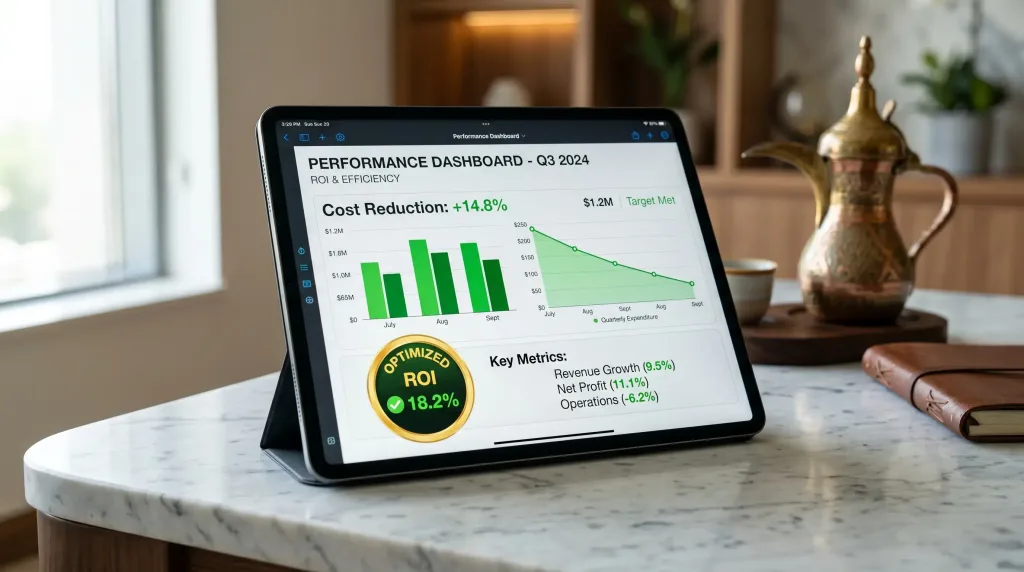
Practical Token Economics: Driving ROI in the GCC
Let’s look at how strategic token management transforms industries across the Gulf:
- Retail & E-commerce (Saudi Arabia): A major retailer uses AI to analyze thousands of Arabic customer reviews daily. By pre-processing and cleaning the data before sending it to the LLM, the CTO drastically reduces the input tokens, cutting their monthly API usage cost by 40% while still extracting precise sentiment analysis.
- Logistics & Ports (UAE): Port authorities deal with massive, multilingual shipping manifests. By utilizing models with an exceptionally high token limit, they can feed entire 300-page logistical reports into the system at once, allowing the AI to instantly cross-reference missing cargo details without memory loss.
- Financial Services (Qatar): Investment firms utilize dynamic model routing. They use cheaper, low-token models for basic data entry tasks, and reserve premium, high-token models strictly for complex market forecasting, ensuring they only pay for high-tier intelligence when absolutely necessary.
Summary: Mastering Your AI Investments
For GCC enterprise leaders, realizing the true token meaning is the bridge between experimenting with AI and profitably deploying it at scale. A token in AI represents your computational fuel. By understanding how to manage your word count in AI, respect the token limit, and optimize your inputs, you can drastically reduce your API usage cost while maximizing operational output.
The most successful companies do not just buy AI; they orchestrate it. You need a platform that automatically handles the complexity of different tokenizers and billing structures, allowing your team to focus on results rather than managing API keys. Optimize your AI costs today: Don’t get locked into expensive contracts or hit unexpected memory limits. With Lexika, you can freely switch between the best AI models on the market, ensuring you always use the most cost-effective and capable engine for your specific token
What exactly is a token in AI?
A token is a piece of a word. It is the basic building block that AI models use to read, process, and generate language.
Why does Arabic text cost more to process than English?
AI models tokenize text based on their training data, which is heavily English-centric. Arabic characters and structures are less common in the base data, so the AI has to break Arabic words down into smaller, more numerous tokens, increasing the cost.
What happens if my document exceeds the token limit?
The AI will truncate the data. It will either refuse the prompt entirely or “forget” the earliest parts of the document, leading to inaccurate or incomplete analysis.
How can I lower my API usage cost?
Keep prompts clear and concise, remove unnecessary formatting from documents before uploading, and use specialized tools that route simpler tasks to cheaper models.
Do all AI models calculate tokens the exact same way?
No. Different companies (like OpenAI, Anthropic, or Google) use different “tokenizers” (the algorithm that splits the words). A sentence might be 10 tokens in GPT-4 but 12 tokens in Claude.
Do longer outputs from the AI increase my costs significantly?
Yes. Output tokens are more expensive than input tokens because they require more computation. If your teams frequently request long summaries or verbose reports, consider setting maximum-length constraints to control cost.
Does compressing or summarizing my documents before uploading reduce token usage?
Absolutely. Pre-cleaning PDFs, removing repeated paragraphs, and compressing logs or transcripts can reduce input token volume by 30–60%, dramatically lowering analysis cost while preserving accuracy.
How do token limits affect real-time business workflows?
Token limits determine how much context the AI can process at once. For workflows like contract review, CRM analysis, or multilingual port documentation, choosing a model with a larger context window prevents memory loss and ensures complete, accurate outputs.