

Manager’s Summary A prompt is the specific instruction or text you feed into an AI to generate a desired outcome. For leaders in the GCC, mastering these instructions is no longer a “tech skill”—it is a strategic lever for scaling productivity and slashing costs. AI is a powerful engine, but without a precise prompt, it is a genius employee without a job description.
The Ignition Key A prompt is the direct command you send to models like GPT-4 or Gemini to guide them toward a task. It can range from a single word to a complex multi-page document of financial data. In Generative AI, the prompt is your ignition key: the quality of your input dictates your ROI.

Search Engines vs. AI: Learning How to Talk to a Bot
Many organizations struggle with AI adoption because they treat these advanced platforms like traditional search engines. This is a costly mistake that limits the technology’s potential.
When you use Google, you type fragmented keywords to find a link. However, figuring out how to talk to a bot requires a complete paradigm shift. You are conversing with a virtual data analyst, copywriter, or senior developer. You must assign the AI a role, a tone, and specific business context. AI models generate responses by predicting the most logical sequence of words based on your instructions. Therefore, the richer and more detailed your initial data is, the more customized and actionable the final output will be.
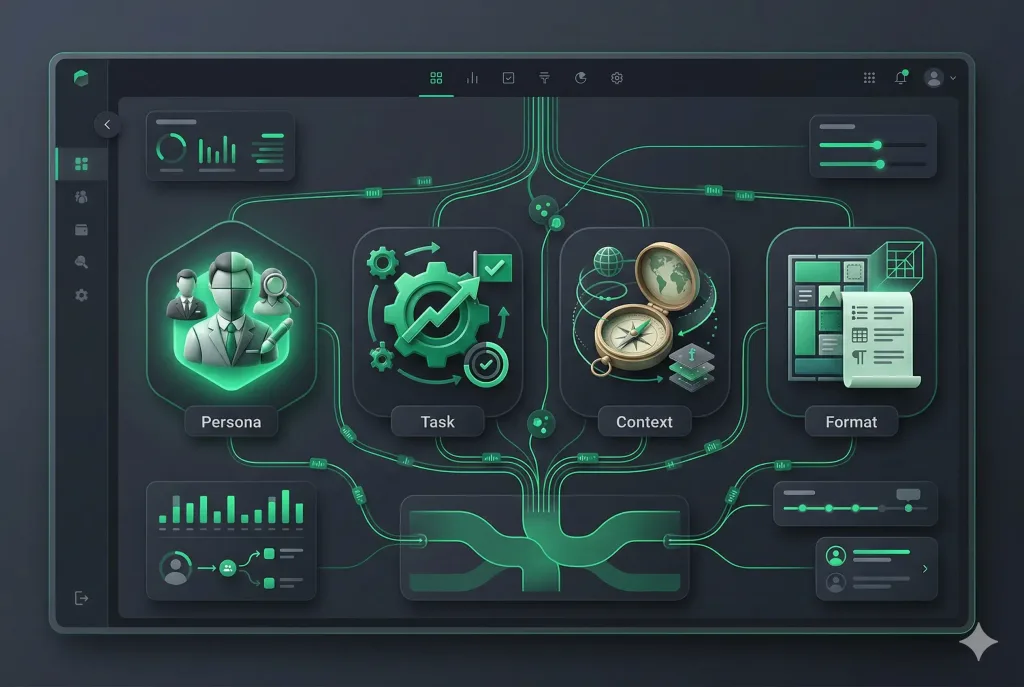
The Anatomy of a Perfect Business Prompt
To truly grasp what is a prompt in an enterprise setting, you must understand its four foundational elements. Crafting a prompt is about building a framework:
- Role and Persona: Tell the AI who it needs to be. (e.g., Act as a Senior Financial Consultant in Dubai…)
- The Specific Task: Clearly state the objective using direct action verbs. (e.g., …write a comprehensive competitor analysis report…)
- Business Context: Provide background information so the output isn’t generic. (e.g., …for a logistics startup focusing on reducing maritime shipping costs in the Gulf…)
- Format and Constraints: Define the exact structure you need. (e.g., …Present the findings in a comparison table and keep the output under 500 words.)
Simple Text Input vs. Prompt Engineering
The practice of designing, testing, and refining these instructions is known as prompt engineering. This skill helps you extract the most accurate output while minimizing API token usage, thereby keeping your operational costs low. The table below illustrates the difference between an amateur approach and a professional strategy:
| Feature | Poor Prompt (Amateur) | Engineered Prompt (Professional) |
| Type of Text Input | Short, vague, lacks business context. (e.g., Write a sales email for our software.) | Comprehensive, defines role, tone, and structure. (e.g., Act as a Sales Director. Write a 300-word formal email to attract B2B investors…) |
| AI Comprehension | Low. The AI is forced to guess the user’s actual intent. | Very high. The AI operates strictly within the defined strategic framework. |
| Business Output | Generic text, unusable as-is, requires heavy human editing and wastes time. | Specialized, highly relevant output ready for immediate deployment or decision-making. |
Driving ROI: Prompt Engineering in the GCC Market
Top-tier reports from firms like McKinsey show that generative AI can unlock trillions of dollars in value. In the Middle East, the companies that win will be the ones that know how to design the right text input to solve their localized challenges:
Logistics and Ports (UAE):
Instead of manually reviewing spreadsheets, operations managers in Dubai’s shipping hubs use complex analytical prompts. They ask the AI to process maritime traffic data and weather patterns to instantly generate route optimization strategies, saving thousands of Dirhams in fuel costs.
Retail and E-commerce (Saudi Arabia):
Marketing teams mastering how to talk to a bot create systematic prompts that generate thousands of localized, Arabic product descriptions in minutes. This drastically improves SEO and conversion rates while eliminating massive copywriting overhead.
Financial Services (Qatar):
Investment analysts utilize prompt engineering to feed lengthy stock market reports into AI platforms, instructing the model to extract a precise executive summary of investment risks and regulatory changes.

Summary: Moving Beyond a Simple Conversation
Now that you understand exactly what is a prompt, you must recognize that mastering the art of writing instructions for AI is the dividing line between traditional companies and market innovators. If your organization cannot effectively communicate its complex challenges to a machine through precise text inputs, even the most expensive AI models will fail to deliver a return on investment. Prompt engineering is the methodology that simplifies this complexity.
However, managing hundreds of daily prompts and constantly choosing between the latest AI models can create technical bottlenecks for your marketing and development teams. You need a secure, flexible environment to streamline this process.
Don’t limit yourself to one model: With lexika, you can forget the complexity of managing multiple API keys. Freely switch between the world’s best AI models—like GPT-4, Claude 3, and Gemini—in one place without changing your underlying code. Compare your prompts live across different models to ensure you always get the most accurate and cost-effective output. Optimize your AI costs today by exploring our plans on the lexika pricing page.
Frequently Asked Questions (FAQ)
1. Exactly what is a prompt in AI tools?
A prompt is your starting point of communication with an AI. It is the specific text, code, or instruction you enter into the system so the language model can process your request and generate a relevant response.
2. Why is learning prompt engineering essential for business leaders?
Leaders who know how to provide precise instructions can automate workflows faster, prevent AI hallucinations (incorrect answers), and ultimately reduce human resource and operational costs significantly.
3. What is the main difference between a prompt and a regular search query?
A search query is designed to find an existing source or webpage. Writing instructions for AI via a prompt is designed to synthesize data and generate entirely new, analytical, or creative content from scratch.
4. Can prompts include confidential corporate data?
Yes, but only if you use secure, enterprise-grade AI platforms. These platforms allow you to input internal business context into your prompts without the risk of your proprietary data being used to train public models.
5. How do we find the best AI model to execute our prompts?
No single model is perfect for every task. Some models excel at understanding coding prompts, while others are better at creative writing. The smartest strategy is using a unified platform that provides access to all top-tier models simultaneously.